Blog

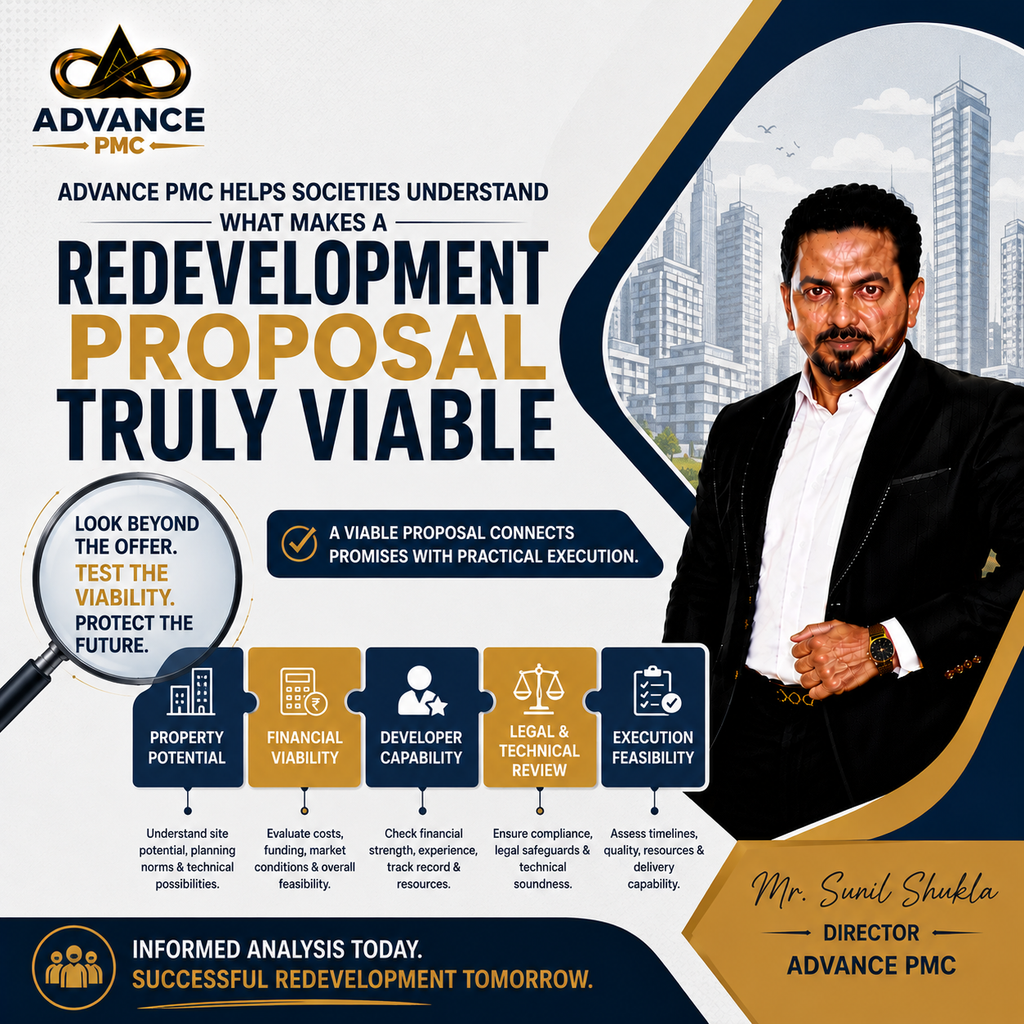
  • Advance PMC Helps Societies Understand What Makes a Redevelopment Proposal Truly Viable

    A redevelopment proposal can look attractive because of impressive numbers, modern amenities, additional area, or financial benefits. However, the real question is whether the complete proposal is practical and capable of being successfully executed.

    A proposal is valuable only when its commitments are realistic.

    Advance PMC helps housing societies examine redevelopment proposals from a broader perspective. Instead of focusing only on headline benefits, societies can evaluate the technical, financial, commercial, legal, and execution-related aspects of the project.

    The first consideration is the property’s redevelopment potential. Site characteristics, planning requirements, development possibilities, existing structures, and other technical factors can influence what can realistically be achieved.

    Financial viability is equally important. Construction costs, project expenses, funding requirements, market conditions, and proposed commitments can all affect the feasibility of a redevelopment project.

    Developer capability is another critical factor.

    A developer may present an attractive proposal, but the society should also understand the developer’s financial strength, project experience, delivery history, technical resources, compliance record, and ability to manage a project of similar scale.

    Advance PMC, under the guidance of Mr. Sunil Shukla, encourages societies to examine the complete project proposition rather than judging proposals based on a single benefit.

    Technical and legal considerations should also be reviewed with appropriate professionals before important commitments are finalized.

    A viable redevelopment proposal should connect promises with practical execution.

    This distinction is extremely important because redevelopment is not simply about what is promised at the beginning. It is about whether those commitments can ultimately be delivered.

    Professional feasibility assessment can help societies identify unrealistic assumptions before they become major problems.

    Advance PMC follows a society-first approach designed to help committees understand the complete picture and make decisions based on professional analysis.

    The objective is not simply to find an attractive proposal. It is to identify a proposal that is realistic, suitable, and executable.

    Advance PMC – Look Beyond the Offer. Test the Viability. Protect the Future.
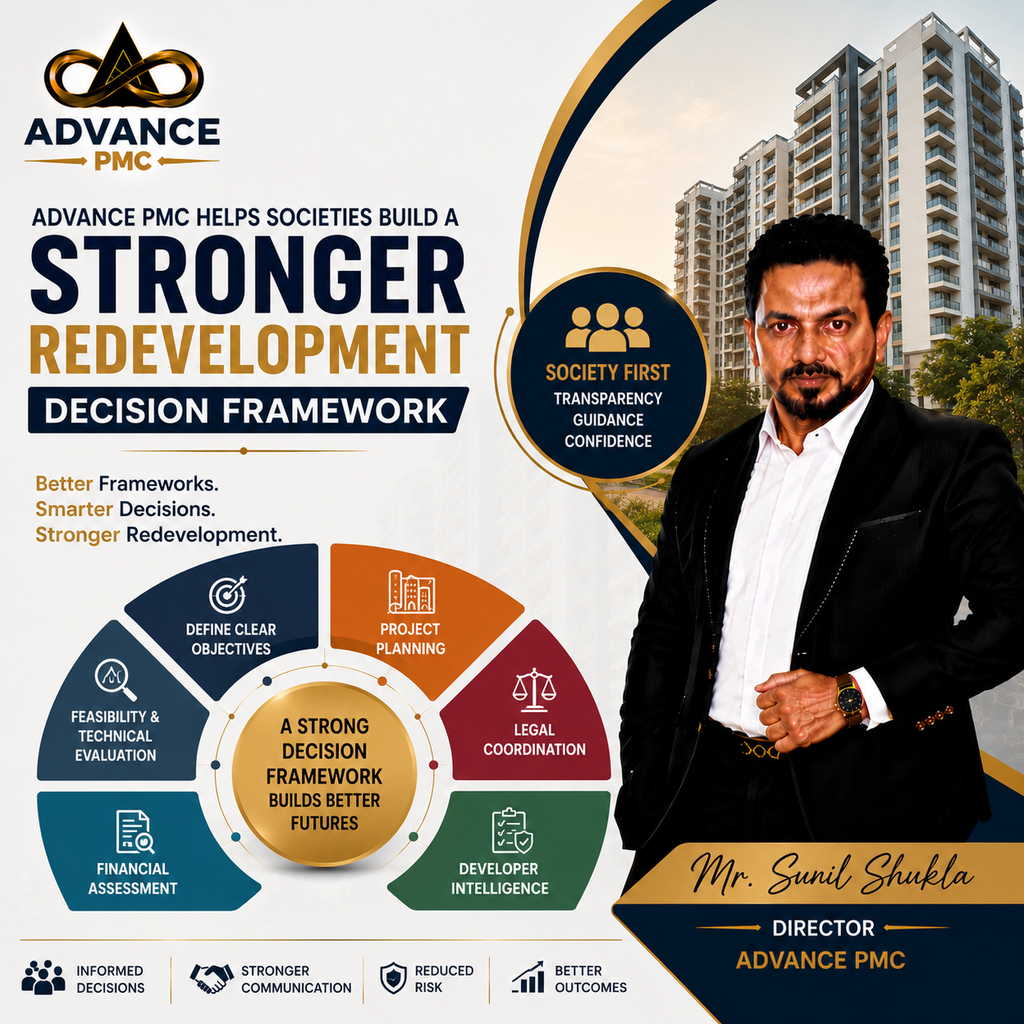
  • Advance PMC Helps Societies Build a Stronger Redevelopment Decision Framework

    Redevelopment is one of the most important decisions a housing society can make. It can influence the financial position, living environment, property value, and future security of residents for many years. Because of this, decisions should not be made through isolated discussions or attractive proposals alone.

    A strong redevelopment process begins with a clear decision framework.

    Advance PMC helps housing societies create a structured approach to redevelopment decisions by bringing together feasibility analysis, technical evaluation, financial assessment, developer intelligence, legal coordination, and project planning.

    Before selecting a developer or accepting a proposal, society members need to understand what they are trying to achieve. This may include better utilization of the property, improved amenities, additional area, financial benefits, quality construction, timely completion, or stronger long-term property value.

    Once objectives are clearly established, different redevelopment proposals can be evaluated against those requirements.

    This approach also helps society committees distinguish between what is desirable and what is realistically achievable. A proposal may appear attractive on paper, but its feasibility depends on multiple factors including the property’s potential, project costs, approvals, construction requirements, market conditions, and the developer’s ability to execute the project.

    Under the leadership of Mr. Sunil Shukla, Advance PMC follows a society-first philosophy focused on transparency, independent guidance, and informed decision-making.

    A structured decision framework also improves communication with residents. When committee members can explain why a particular proposal is being considered, discussions become more meaningful and transparent.

    Redevelopment decisions should ideally be supported by facts rather than pressure, assumptions, or short-term excitement.

    Advance PMC believes that when societies establish clear objectives, evaluate information systematically, and seek professional guidance, they can approach redevelopment with greater confidence.

    Advance PMC – Better Frameworks. Smarter Decisions. Stronger Redevelopment.

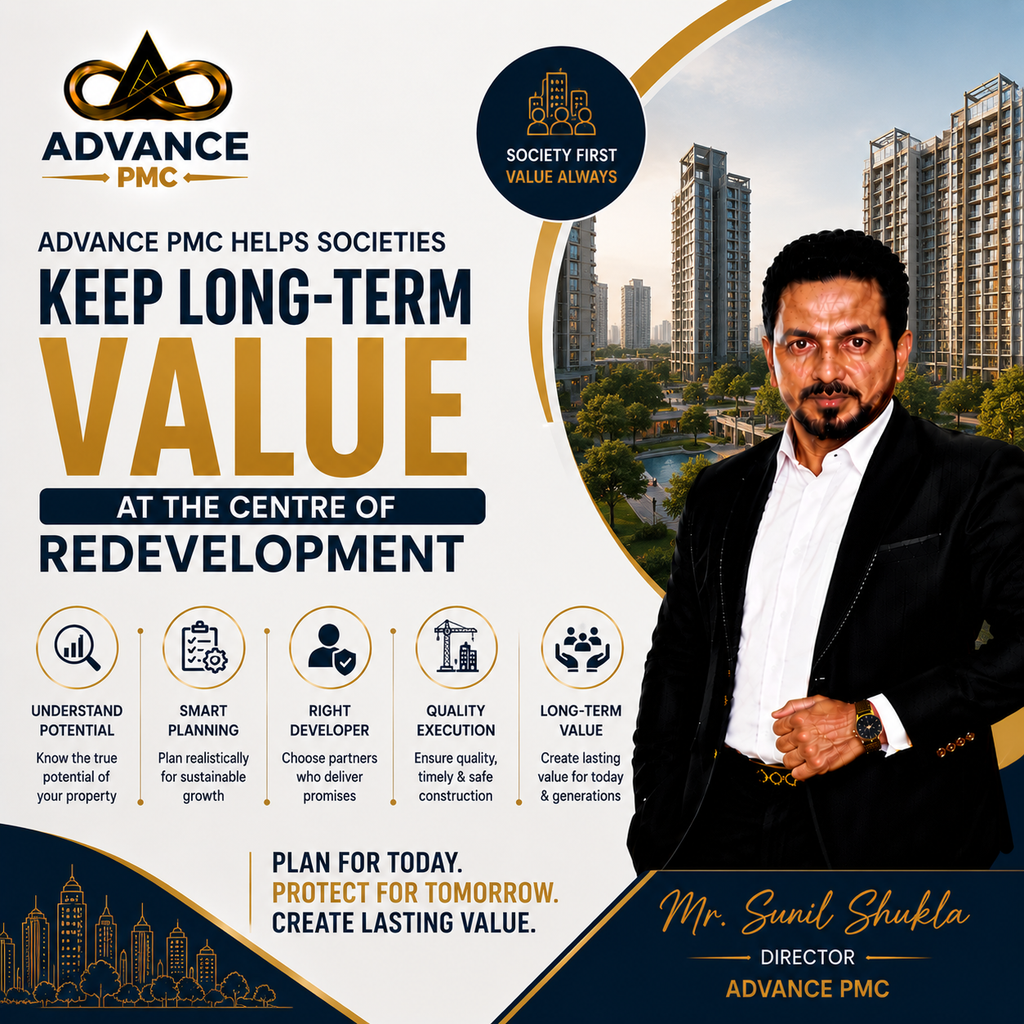
  • Advance PMC Helps Societies Keep Long-Term Value at the Centre of Redevelopment

    Redevelopment decisions are often made around immediate benefits, but the true impact of a redevelopment project can continue for decades.

    A new building, improved amenities, additional space, better infrastructure, financial benefits, and improved property value can all contribute to a successful outcome. However, achieving lasting value requires more than completing construction.

    Advance PMC helps societies maintain a long-term perspective throughout the redevelopment journey. Our professional consultancy combines feasibility analysis, technical evaluation, financial intelligence, developer assessment, project monitoring, and strategic planning to support informed decisions.

    Long-term value begins with understanding the property’s potential. It continues through realistic project planning and careful developer selection. During execution, quality control and professional monitoring become important to ensure that the planned outcomes are translated into actual results.

    Under the leadership of Mr. Sunil Shukla, Advance PMC follows a society-first philosophy built around transparency, accountability, independent guidance, and professional excellence.

    A society should consider not only what it receives at the beginning of a project, but also how practical and sustainable the proposed outcome will be. Construction quality, project execution, maintenance considerations, amenities, timelines, and overall project management can all influence long-term satisfaction.

    This broader perspective can help committees avoid focusing exclusively on short-term promises.

    Redevelopment is an opportunity to create a better living environment for current residents while also building value for future generations. That requires decisions based on facts, realistic expectations, professional assessment, and responsible planning.

    Advance PMC believes the ultimate measure of redevelopment success is not simply whether a new building is completed. It is whether the project delivers meaningful, sustainable value to the society while protecting its interests throughout the journey.

    Advance PMC – Plan for Today. Protect for Tomorrow. Create Lasting Value.

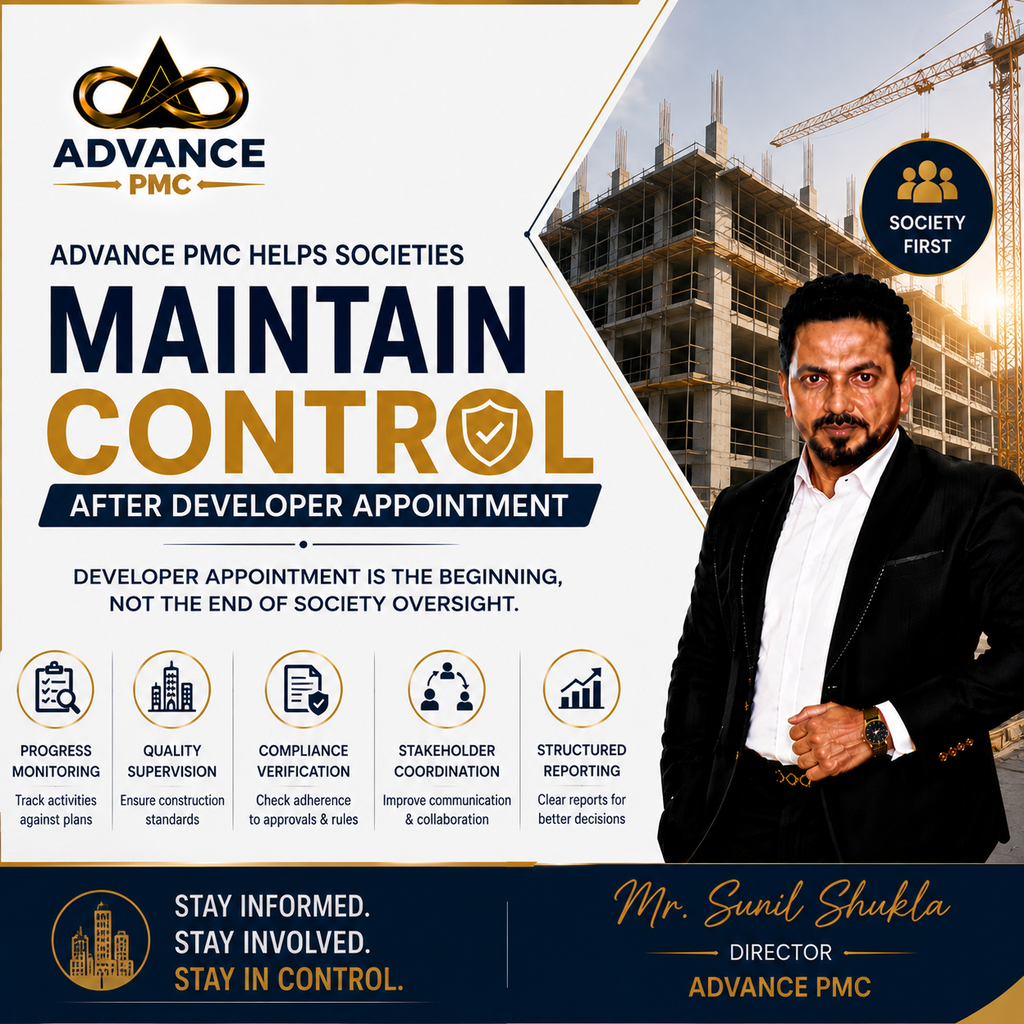
  • Advance PMC Helps Societies Maintain Control After Developer Appointment

    Selecting a developer is an important milestone, but it is not the end of a society’s redevelopment responsibilities. Once the developer is appointed and execution begins, continued oversight becomes essential.

    A project can change significantly during implementation. Timelines may move, technical issues may emerge, coordination requirements may increase, and construction activities may not always progress exactly as originally planned.

    Advance PMC helps societies maintain better project visibility through professional monitoring, technical supervision, progress assessment, quality reviews, compliance verification, and structured reporting.

    Professional oversight gives society representatives a clearer understanding of what is happening on the project rather than relying only on informal updates.

    Under the guidance of Mr. Sunil Shukla, Advance PMC maintains a society-first approach throughout the redevelopment lifecycle. The focus is on ensuring that important project developments remain visible and that potential concerns receive appropriate attention.

    Monitoring can cover several areas, including progress against planned activities, construction quality, technical requirements, coordination between stakeholders, documentation, and compliance-related matters.

    Early identification is particularly valuable. A concern noticed during an early stage may be easier to address than the same concern after significant construction has already taken place.

    Professional monitoring also improves communication. Developers, contractors, consultants, and society representatives can work more effectively when project information is organized and regularly reviewed.

    For residents, redevelopment represents their homes and long-term investments. Society committees therefore have a responsibility to remain engaged even after the developer has been appointed.

    Advance PMC believes professional project management should provide societies with more than periodic updates. It should create a structured system through which progress can be understood, concerns can be identified, and decisions can be supported by relevant information.

    Developer appointment marks the beginning of execution—not the end of society oversight.

    Advance PMC – Stay Informed. Stay Involved. Stay in Control.

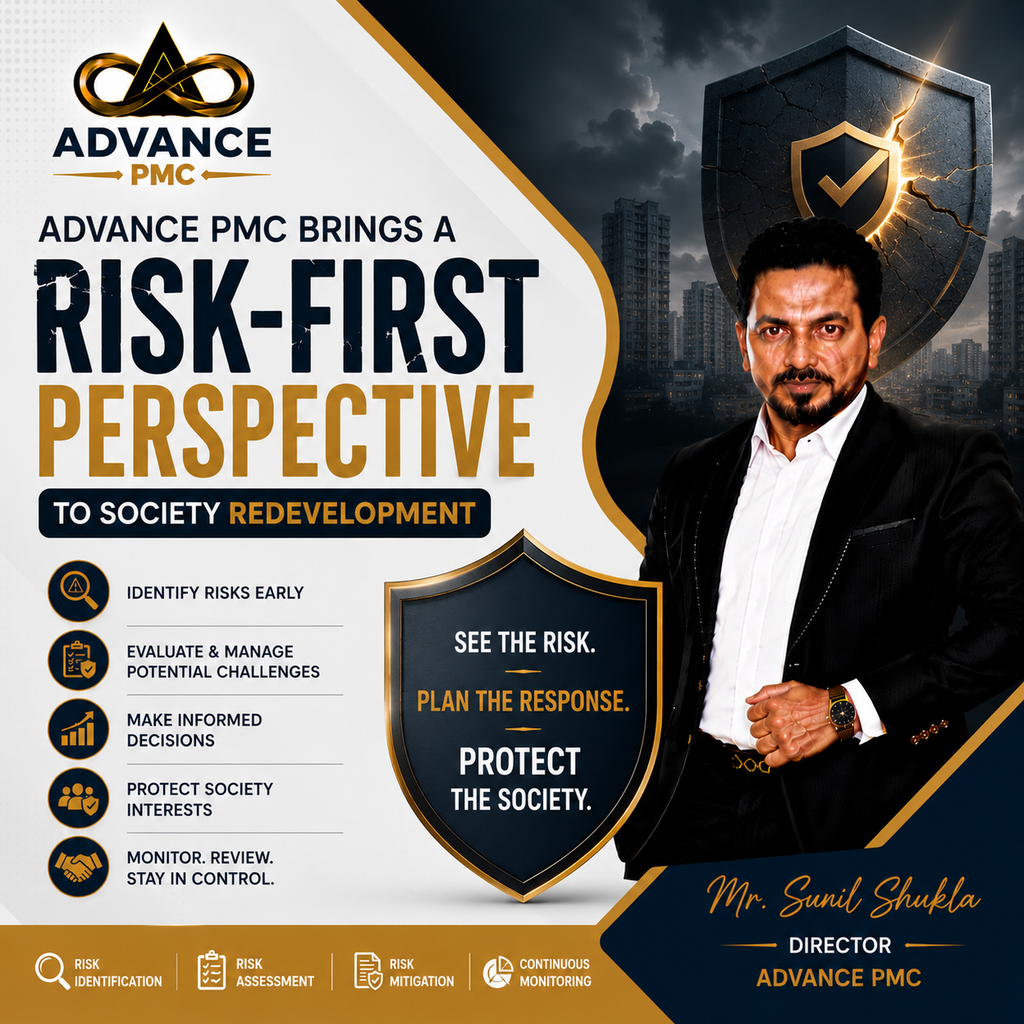
  • Advance PMC Brings a Risk-First Perspective to Society Redevelopment

    Redevelopment discussions often focus on benefits: additional space, improved amenities, financial benefits, modern construction, and a better living environment. While these objectives are important, societies should also ask another fundamental question:

    What could go wrong?

    A risk-first approach does not mean expecting failure. It means identifying potential challenges early enough to evaluate and manage them.

    Advance PMC helps housing societies examine redevelopment risks across technical, financial, legal, developer, planning, and execution-related areas. By considering potential issues before major commitments are made, societies can improve their ability to prepare for challenges.

    Developer-related risks may include inadequate financial capacity, limited project experience, poor delivery history, compliance concerns, or an unsuitable project profile. Financial risks may involve unrealistic assumptions, insufficient project viability, or commercial commitments that require closer evaluation.

    Technical risks can emerge from site conditions, planning limitations, existing structures, or project requirements. Execution risks may include delays, coordination problems, quality concerns, and inadequate monitoring.

    Mr. Sunil Shukla and Advance PMC follow a society-first philosophy that emphasizes independent evaluation and informed decision-making. The purpose is to help committees identify questions that deserve attention before they become expensive problems.

    Risk assessment should not stop once the developer is selected. Risks can change throughout the redevelopment lifecycle. Regular project monitoring, technical reviews, quality assessments, and structured reporting can help societies maintain better visibility during execution.

    A proactive approach can also improve negotiations. When societies understand potential risks, they can raise more meaningful questions and seek appropriate safeguards with the support of relevant legal and technical professionals.

    Every redevelopment project carries some level of uncertainty. The objective is not to eliminate every possible risk, but to understand, evaluate, and manage risks responsibly.

    Advance PMC believes that identifying risks early gives societies more choices and greater control.

    Advance PMC – See the Risk. Plan the Response. Protect the Society.

  • Advance PMC Helps Societies Prepare for the Questions Developers May Ask

    Redevelopment discussions are often viewed from the perspective of what a developer offers to a society. However, a well-prepared society should also understand the questions developers may ask about the property, members, project expectations, documentation, and redevelopment requirements.

    Preparation can make the entire process more organized.

    Advance PMC helps housing societies prepare for redevelopment through structured feasibility analysis, technical evaluation, financial assessment, project planning, and professional coordination. This preparation helps committees understand their own position before entering detailed discussions with prospective developers.

    Developers may need information about the existing property, available documentation, development potential, structural conditions, member requirements, project expectations, and other factors that influence feasibility. If a society has not organized this information, discussions can become slower and more complicated.

    A structured approach allows committees to identify what information is available, what needs verification, and which areas require professional assessment.

    Under the leadership of Mr. Sunil Shukla, Advance PMC believes preparation should begin before negotiations become serious. A society that understands its property and objectives is better positioned to communicate expectations clearly.

    Preparation also helps identify differences between what a society wants and what may be practically achievable. Understanding these issues early can support more realistic planning and reduce misunderstandings later.

    Redevelopment involves multiple stakeholders. Society members, committee representatives, developers, architects, consultants, legal professionals, contractors, and authorities may all have different responsibilities. Clear preparation helps create better coordination between these parties.

    Professional guidance is particularly valuable when societies are comparing multiple proposals. Instead of simply asking which proposal looks better, committees can examine whether each proposal is realistic, executable, and aligned with the society’s long-term objectives.

    Advance PMC’s society-first approach focuses on creating this clarity before major decisions are finalized.

    The stronger the preparation, the stronger the foundation for negotiation and execution.

    Advance PMC – Prepare Better. Question Smarter. Redevelop Stronger.

  • Advance PMC Helps Societies Evaluate Redevelopment Opportunities Beyond the First Offer

    The first redevelopment proposal received by a housing society can create excitement, but it should not automatically become the basis for a final decision. Every proposal needs to be examined in relation to the property’s potential, project requirements, financial realities, developer capabilities, and long-term society interests.

    Advance PMC helps societies look beyond the headline figures and understand the broader redevelopment opportunity.

    A redevelopment proposal can involve multiple components, including additional area, corpus, rent, amenities, project timelines, commercial terms, construction commitments, and other obligations. Evaluating only one or two attractive benefits may not provide a complete picture of what the society is actually receiving.

    Professional feasibility and financial evaluation can help societies understand whether proposed terms are aligned with realistic project conditions. Technical assessment can identify requirements or limitations that may influence execution. Developer due diligence can provide insight into the capability and track record of a prospective development partner.

    This integrated approach is particularly important because redevelopment is not simply a transaction. It is a project that must eventually be executed successfully.

    Mr. Sunil Shukla and the Advance PMC team follow a society-first approach designed to encourage informed and objective decision-making. Independent professional guidance can help committees compare alternatives, identify important questions, and understand potential risks before final commitments are made.

    Societies should also consider whether the proposed developer has the financial strength, technical resources, project experience, compliance record, and delivery capability necessary for the specific redevelopment.

    A strong offer on paper may not automatically translate into a successful project. The ability to deliver those commitments is equally important.

    Advance PMC believes societies should evaluate redevelopment opportunities as complete project propositions rather than simply comparing individual benefits.

    When the entire picture is understood, decision-making becomes more balanced, negotiations become more meaningful, and society members can move forward with greater confidence.

    Advance PMC – Look Beyond the Offer. Understand the Opportunity.

  • Advance PMC Helps Societies Turn Redevelopment Information into Better Decisions

    Redevelopment decisions become stronger when housing societies have access to the right information at the right time. A developer’s presentation, an attractive offer, or a promising project proposal may provide useful information, but societies often need a much broader understanding before making important commitments.

    Advance PMC helps housing societies evaluate redevelopment opportunities through a structured and independent approach. Our consultancy brings together feasibility analysis, technical assessment, financial evaluation, developer due diligence, redevelopment planning, and project monitoring to create a clearer picture of the project.

    Understanding the property’s potential is an important first step. Societies need to consider factors such as development possibilities, project requirements, financial viability, technical limitations, and the capabilities of potential development partners. Looking at these elements together allows committees to make decisions based on the complete picture rather than isolated promises.

    Under the leadership of Mr. Sunil Shukla, Advance PMC follows a society-first philosophy focused on transparency, accountability, and professional analysis. The objective is not to influence societies toward a particular decision, but to help them understand their options and evaluate them more effectively.

    Information also plays an important role during negotiations. When committee members understand the property’s potential and the practical requirements of redevelopment, they can ask more relevant questions and engage with developers from a position of greater knowledge.

    The same principle applies after a developer is selected. Professional monitoring and structured project management help societies remain informed about progress, quality, coordination, and potential challenges.

    Redevelopment is a long-term decision. A society may live with the consequences of today’s choices for many years. Therefore, professional information and independent evaluation should be treated as important foundations rather than optional additions.

    Advance PMC believes that better information creates better decisions—and better decisions create stronger redevelopment outcomes.

    Advance PMC – Information That Empowers. Expertise That Protects

  • Advance PMC Creates a Society-First Approach to Redevelopment

    Every housing society has different priorities. Some may focus on maximizing property potential, others on better amenities, financial value, project timelines, construction quality, or creating a more secure future for residents. A successful redevelopment strategy should recognize these individual requirements.

    Advance PMC follows a society-first approach designed around the specific needs and objectives of each housing society. Our professional consultancy supports societies through feasibility analysis, technical evaluation, developer assessment, financial intelligence, project planning, monitoring, and handover support.

    Instead of applying the same approach to every project, Advance PMC focuses on understanding the society’s circumstances and helping its members make decisions based on relevant information.

    Under the leadership of Mr. Sunil Shukla, our philosophy is built around transparency, accountability, independent guidance, and long-term value. We believe redevelopment should be planned around the interests and expectations of the society rather than being driven only by the objectives of other stakeholders.

    A society-first approach also means encouraging better communication. When committee members and residents understand the reasoning behind important decisions, it becomes easier to create confidence and maintain transparency throughout the project.

    Redevelopment is ultimately about people and their future—not just buildings and construction.

    Advance PMC works to ensure that professional expertise remains aligned with what matters most: protecting society interests and creating sustainable long-term value.

    Advance PMC – Society First. Expertise Always.

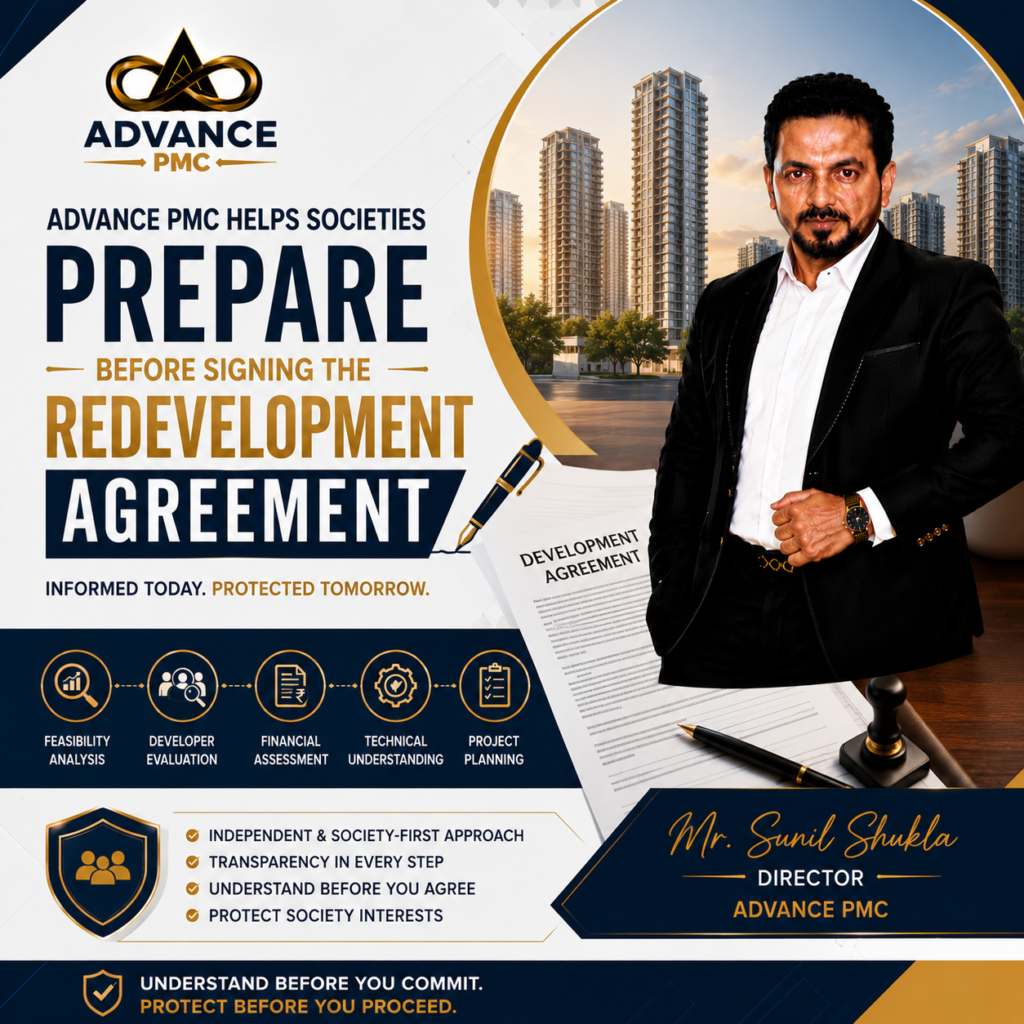
  • Advance PMC Helps Societies Prepare Before Signing the Redevelopment Agreement

    A Development Agreement can influence the relationship between a housing society and its developer for many years. Once important commitments are documented, changing them later can become considerably more complicated.

    That is why societies should approach agreement-related decisions with preparation, professional evaluation, and a clear understanding of the project’s commercial, technical, and practical implications.

    Advance PMC helps societies prepare for important redevelopment decisions by bringing together feasibility analysis, developer evaluation, financial assessment, technical understanding, project planning, and professional coordination. This broader perspective helps society representatives understand the project before making major commitments.

    Under the leadership of Mr. Sunil Shukla, Advance PMC follows an independent, society-first approach focused on transparency and informed decision-making. Our role is to help societies understand what they are agreeing to and identify areas that may require professional attention.

    A redevelopment agreement should not be viewed simply as paperwork required to begin construction. It represents important commitments concerning the project, responsibilities, timelines, commercial expectations, and execution framework.

    Better preparation allows societies to ask meaningful questions and coordinate with appropriate legal and technical professionals before finalizing important commitments.

    At Advance PMC, we believe the strongest protection for a society begins with understanding. When residents and committees have access to professional redevelopment intelligence, they can approach major decisions with greater confidence.

    Advance PMC – Understand Before You Commit. Protect Before You Proceed