Blog

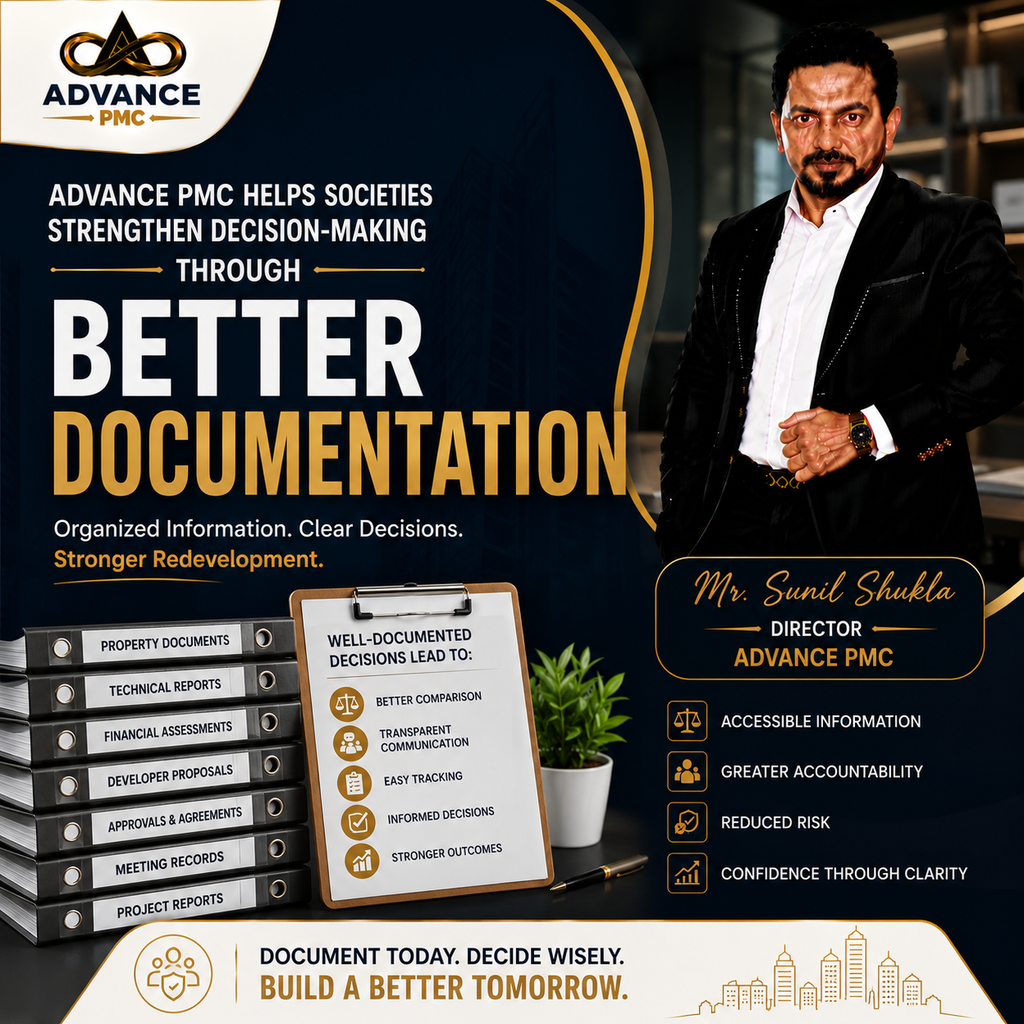
  • Advance PMC Helps Societies Strengthen Decision-Making Through Better Documentation

    Redevelopment involves a significant amount of information.

    Property documents, technical reports, financial assessments, developer proposals, correspondence, approvals, meeting records, agreements, project reports, and other documents can influence important decisions.

    Without proper organization, valuable information can become difficult to access when it is needed most.

    Advance PMC helps societies bring greater structure to the redevelopment decision-making process by encouraging systematic evaluation and documentation.

    Before major commitments are made, societies can benefit from maintaining a clear information base covering property details, redevelopment potential, technical considerations, financial expectations, developer information, project objectives, and important decisions.

    Proper documentation can also improve communication among committee members and professional consultants.

    When information is organized, it becomes easier to compare proposals, understand changes, track decisions, and identify areas requiring further professional review.

    Under the guidance of Mr. Sunil Shukla, Advance PMC follows a society-first philosophy built around transparency, accountability, and informed decision-making.

    Documentation becomes even more important during project execution.

    Progress reports, technical observations, quality reviews, approvals, correspondence, and project updates can help create a clearer record of what has occurred throughout the redevelopment journey.

    Good documentation is not simply about storing paperwork.

    It is about creating an accessible knowledge base that supports responsible decision-making.

    A society making a long-term property decision should be able to understand why important choices were made, what information supported those choices, and how project developments are being monitored.

    Professional redevelopment consultancy can help bring greater structure to this process.

    Advance PMC – Organized Information. Clear Decisions. Stronger Redevelopment.
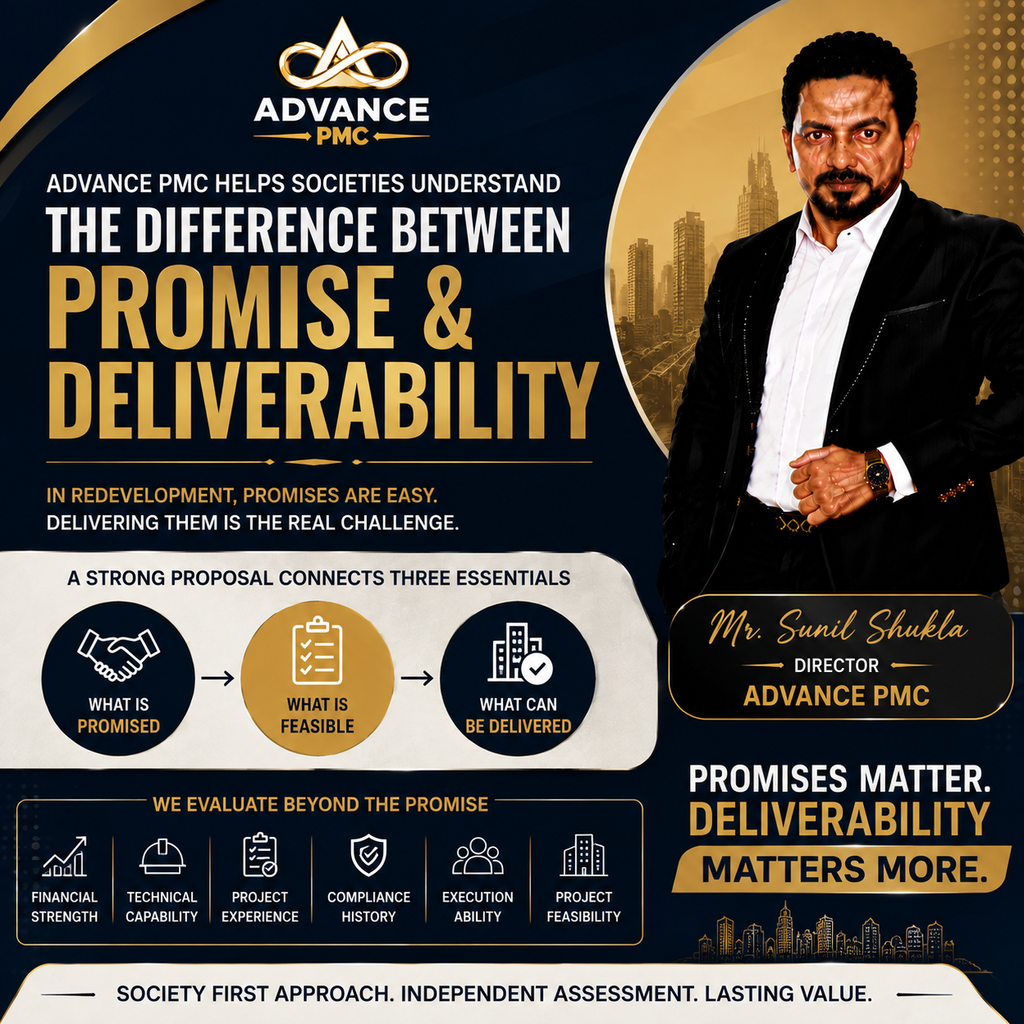
  • Advance PMC Helps Societies Understand the Difference Between Promise and Deliverability

    In redevelopment, promises are easy to present.

    Delivering those promises is the real challenge.

    A developer may present attractive financial benefits, modern amenities, additional area, impressive timelines, and ambitious project plans. However, every commitment should ultimately be evaluated against the developer’s ability to execute it.

    Advance PMC helps housing societies understand this difference.

    Professional redevelopment evaluation looks beyond what is promised and examines whether the proposed outcome is technically, financially, and operationally realistic.

    A developer’s financial capability can influence the ability to maintain project momentum. Previous project performance can provide useful insight into delivery experience. Technical resources can influence execution quality. Compliance history and project management capabilities can also affect redevelopment outcomes.

    The property’s own characteristics are equally important.

    Development potential, planning requirements, site conditions, construction considerations, project costs, and market conditions can all influence what is realistically achievable.

    Advance PMC brings these factors together through feasibility analysis, developer due diligence, financial evaluation, technical assessment, and professional project planning.

    Under the leadership of Mr. Sunil Shukla, Advance PMC maintains a society-first approach focused on independent assessment and long-term society interests.

    This does not mean that every developer commitment should be viewed negatively.

    It means commitments should be understood, evaluated, and supported by appropriate professional assessment.

    A strong redevelopment proposal connects three important elements:

    What is promised.
    What is feasible.
    What can actually be delivered.

    When these three elements are aligned, societies can approach redevelopment discussions with greater confidence.

    The goal is not to choose the developer making the biggest promise.

    The goal is to understand who can realistically deliver the agreed outcome.

    Advance PMC – Promises Matter. Deliverability Matters More..

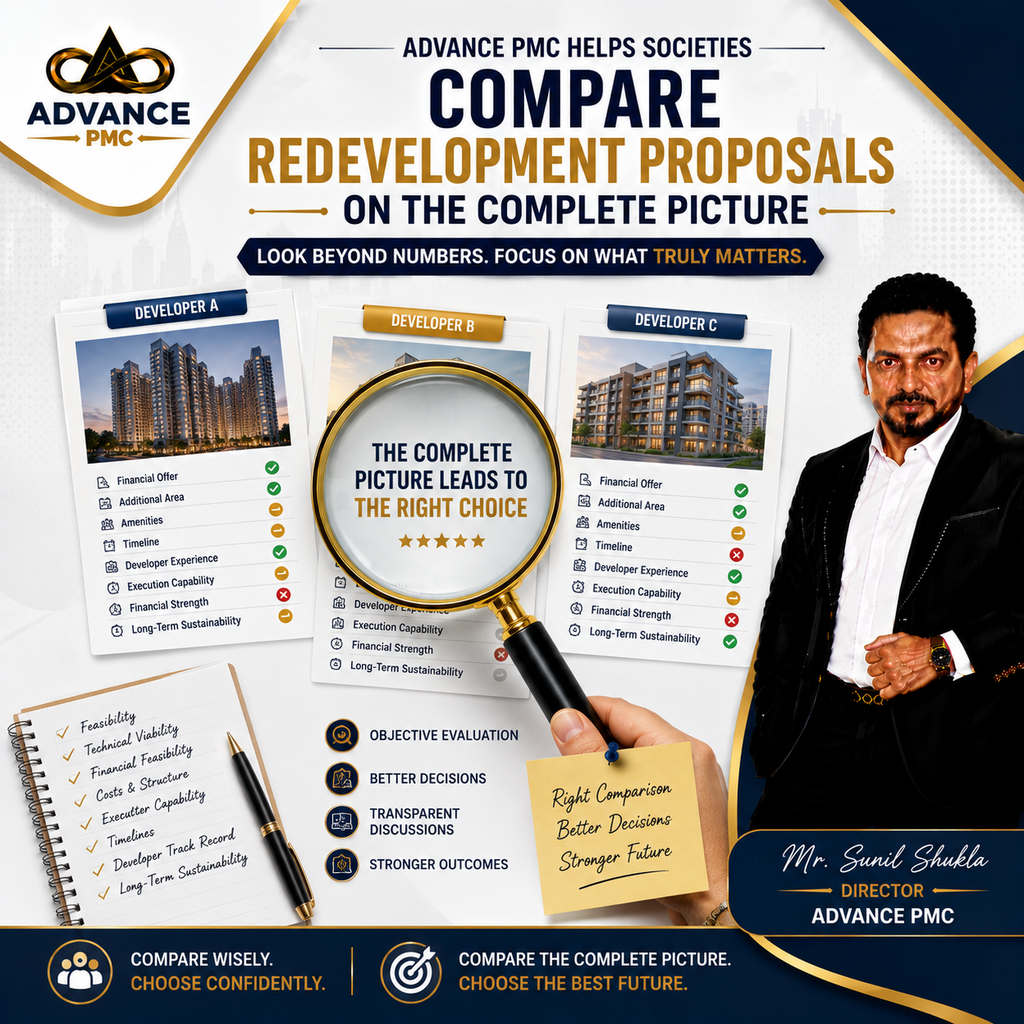
  • Advance PMC Helps Societies Compare Redevelopment Proposals on the Complete Picture

    When multiple developers approach a housing society, comparing proposals can become challenging.

    One developer may offer a higher corpus. Another may propose better amenities. Someone else may offer additional area or a different commercial structure.

    Simply choosing the proposal with the biggest number may not always lead to the best outcome.

    Advance PMC helps societies evaluate redevelopment proposals by looking beyond individual benefits and considering the complete project proposition.

    A proposal should be examined in relation to the property’s redevelopment potential, technical requirements, financial feasibility, project costs, execution capabilities, proposed timelines, developer experience, and long-term sustainability.

    For example, an attractive financial offer may appear beneficial initially, but societies should also understand how the developer intends to fund and execute the project.

    Similarly, additional area may be attractive, but its practicality depends on technical and planning considerations.

    Developer capability is equally important. The ability to deliver commitments should be evaluated alongside the commitments themselves.

    Advance PMC provides professional support through feasibility assessment, developer intelligence, financial analysis, technical evaluation, and redevelopment planning.

    Under the guidance of Mr. Sunil Shukla, the company follows an independent, society-first approach designed to help committees evaluate information objectively.

    A structured comparison can also make discussions among society members more transparent. Instead of focusing on isolated benefits, committees can establish meaningful criteria and evaluate proposals against those criteria.

    The objective should not simply be to identify the most attractive presentation.

    It should be to understand which proposal offers a realistic, suitable, and executable path toward successful redevelopment.

    Every society deserves the opportunity to evaluate its choices with clarity before making a long-term commitment.

    Advance PMC – Compare the Complete Picture. Choose with Clarity.

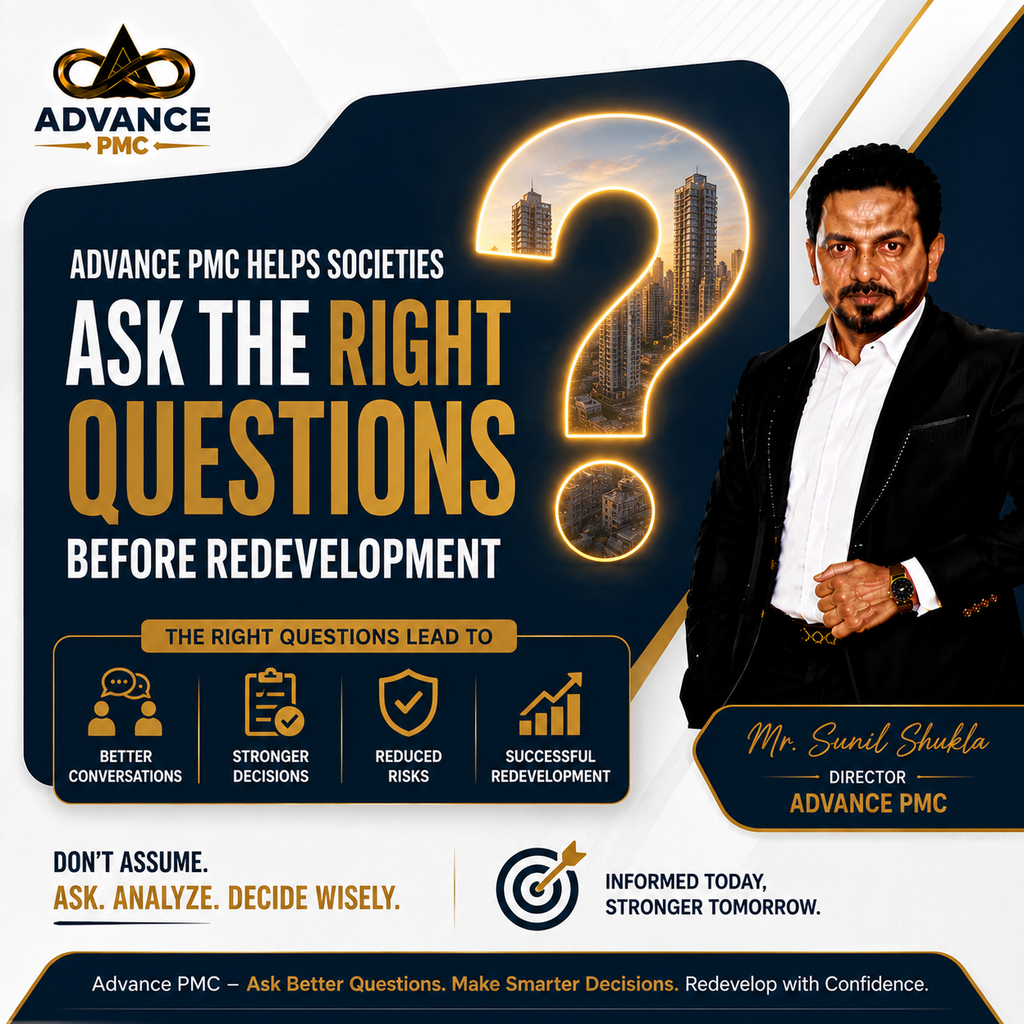
  • Advance PMC Helps Societies Ask the Right Questions Before Redevelopment

    Redevelopment is a major decision, and the quality of the questions asked before the project begins can significantly influence the quality of the decisions that follow.

    Housing societies often receive presentations from developers containing attractive proposals, financial benefits, amenities, timelines, and project concepts. While these details are important, societies also need to ask what lies behind those commitments.

    Is the proposed development technically feasible?
    Does the financial structure make practical sense?
    Can the developer realistically deliver the promised benefits?
    Are the proposed timelines achievable?
    What risks could affect the project?

    Advance PMC helps housing societies approach redevelopment with a structured questioning and evaluation process. Through feasibility analysis, financial assessment, technical evaluation, developer due diligence, legal coordination, and project planning, societies can examine the complete picture before making important commitments.

    Under the leadership of Mr. Sunil Shukla, Advance PMC follows a society-first philosophy focused on independent guidance, transparency, and informed decision-making.

    Asking the right questions does not mean creating unnecessary obstacles. It means ensuring that important assumptions are examined before they become commitments.

    A society that understands its property potential can have more meaningful discussions with developers. A society that understands financial implications can evaluate commercial proposals more effectively. A society that understands technical requirements can recognize unrealistic expectations earlier.

    The same principle applies during execution. Questions about construction progress, quality, approvals, timelines, documentation, and project coordination can help committees maintain better visibility.

    Redevelopment is too important to be guided by assumptions alone.

    The right questions create better conversations. Better conversations create better decisions. And better decisions can create stronger redevelopment outcomes.

    Advance PMC believes professional consultancy should help societies not only find answers, but also identify the questions that matter most.

    Advance PMC – Ask Better Questions. Make Smarter Decisions. Redevelop with Confidence.

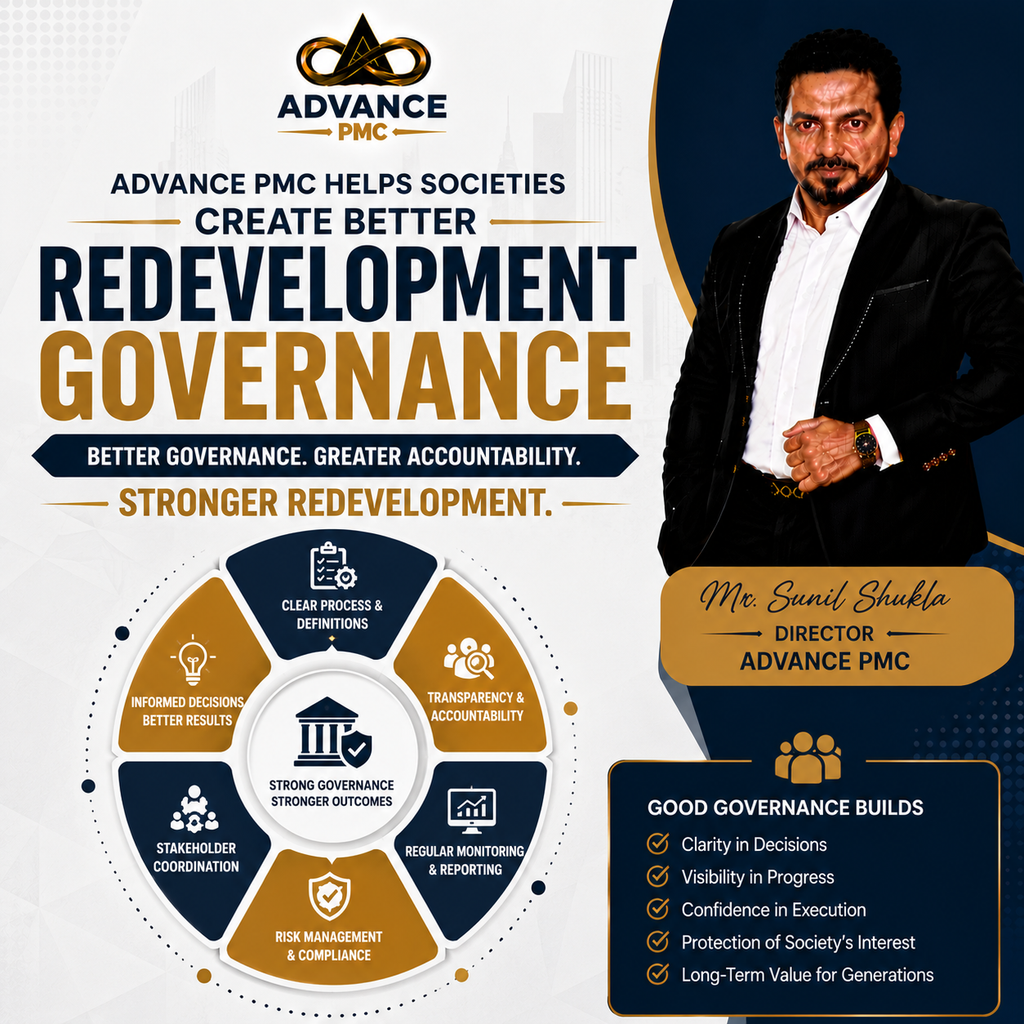
  • Advance PMC Helps Societies Create Better Redevelopment Governance

    Redevelopment involves multiple decisions, stakeholders, documents, responsibilities, and milestones. Without an organized governance structure, important matters can become difficult to track.

    Advance PMC helps housing societies introduce greater structure and accountability into the redevelopment process.

    Redevelopment governance involves understanding who is responsible for what, how decisions are evaluated, how progress is monitored, and how important information is communicated.

    A structured governance approach can begin even before a developer is appointed.

    Feasibility studies, developer evaluations, financial assessments, technical reports, legal coordination, and project planning can create an information base for better decision-making.

    Once execution begins, governance becomes even more important.

    Society representatives need visibility into project progress, construction quality, approvals, technical matters, timelines, documentation, and stakeholder coordination.

    Advance PMC provides professional project management and monitoring support to help societies maintain this visibility.

    Under the guidance of Mr. Sunil Shukla, Advance PMC follows a society-first philosophy built around transparency, accountability, and independent professional guidance.

    Good governance does not mean creating unnecessary complexity. It means establishing a clear process through which important matters are reviewed and decisions are supported by appropriate information.

    Regular reporting can help society committees understand developments.

    Technical reviews can help identify potential concerns.

    Progress monitoring can help compare actual activities with planned milestones.

    Structured coordination can help reduce confusion between developers, consultants, contractors, and society representatives.

    Governance is especially important when unexpected situations arise. A society with an organized decision-making framework is better positioned to evaluate the issue, seek appropriate professional advice, and determine the next course of action.

    Redevelopment represents a major investment of time, money, and trust.

    Professional governance can help protect that investment by ensuring that important decisions are not left to assumptions or informal communication.

    Advance PMC believes that successful redevelopment requires not only construction expertise, but also strong project governance.

    Advance PMC – Better Governance. Greater Accountability. Stronger Redevelopment.

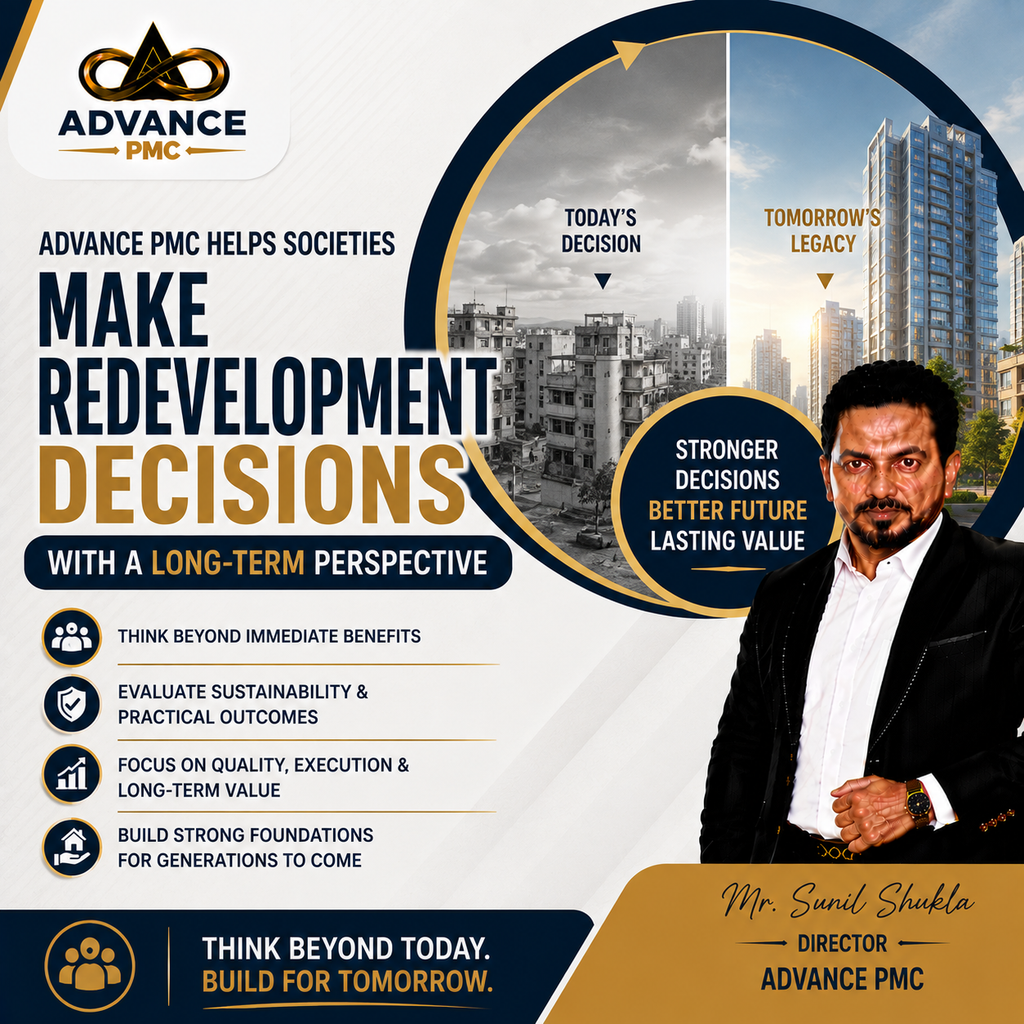
  • Advance PMC Helps Societies Make Redevelopment Decisions with a Long-Term Perspective

    Redevelopment decisions made today can influence society members for decades.

    That makes it important to look beyond immediate benefits and consider the long-term consequences of every major decision.

    Advance PMC helps housing societies evaluate redevelopment through a long-term perspective. The objective is to consider not only what a society receives at the beginning, but also how sustainable and practical the overall outcome will be.

    A redevelopment project may offer additional area, amenities, financial benefits, improved infrastructure, and a modern building. These are important considerations, but they should be evaluated alongside construction quality, project execution, maintenance implications, timelines, and long-term property value.

    A strong redevelopment decision considers the complete lifecycle.

    Under the leadership of Mr. Sunil Shukla, Advance PMC follows a society-first approach focused on transparency, professional analysis, and long-term value.

    Feasibility analysis can help societies understand whether proposed outcomes are realistically achievable.

    Developer evaluation can help determine whether the selected development partner has the ability to execute the project.

    Financial analysis can help societies understand the broader commercial implications.

    Technical evaluation can identify important project considerations before and during construction.

    Professional monitoring can then help ensure that execution remains aligned with agreed expectations.

    Each of these stages contributes to the final outcome.

    This long-term perspective can also help societies avoid focusing exclusively on short-term promises. A proposal that looks attractive initially may not necessarily provide the strongest overall outcome if execution capability, quality, timelines, or financial sustainability are weak.

    Redevelopment should create value that residents can benefit from for many years.

    Advance PMC believes societies should therefore ask not only, “What are we getting today?” but also, “What will this decision mean for us tomorrow?”

    When redevelopment decisions are made with the future in mind, societies can build stronger foundations for lasting value.

    Advance PMC – Think Beyond Today. Build for Tomorrow.

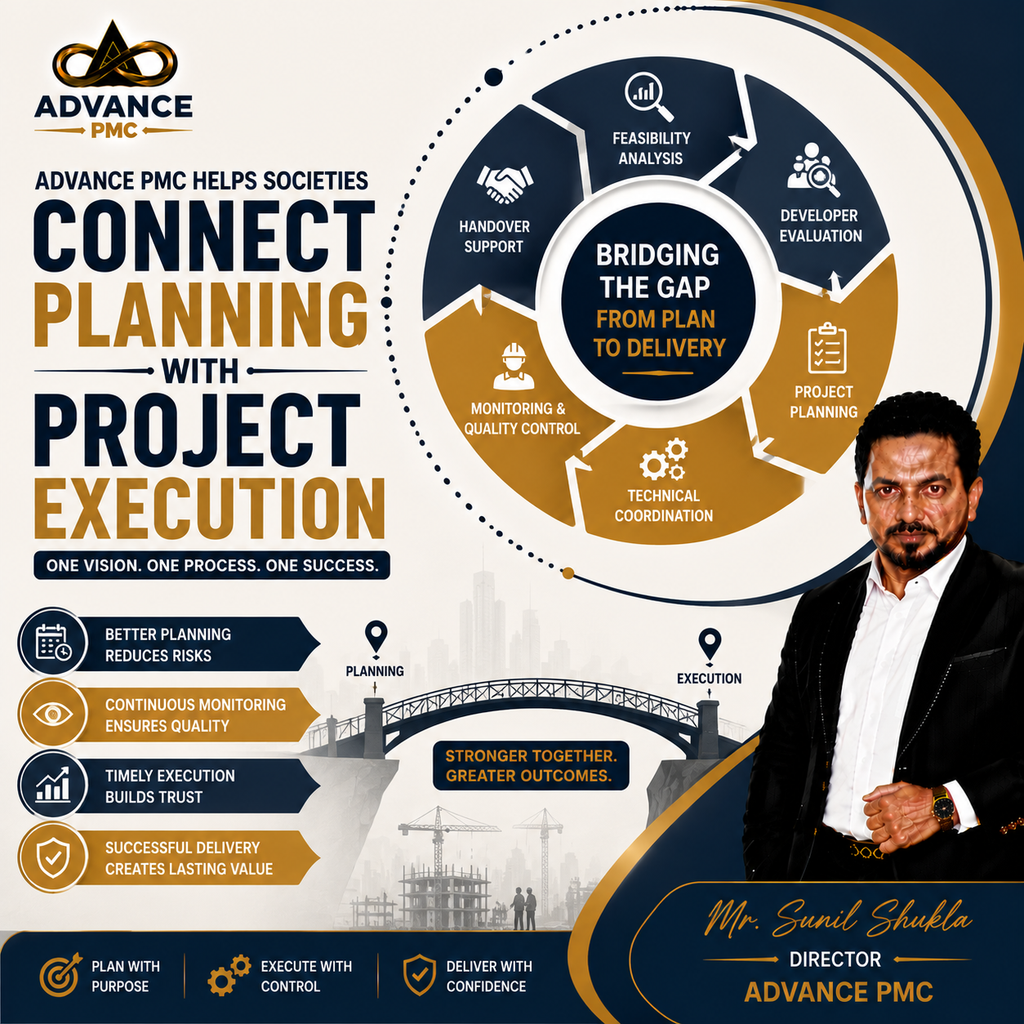
  • Advance PMC Helps Societies Connect Planning with Project Execution

    One of the common challenges in redevelopment is the gap between planning and execution.

    A project may begin with detailed discussions, attractive proposals, and ambitious commitments. But successful redevelopment ultimately depends on whether those plans can be translated into actual execution.

    Advance PMC helps societies maintain continuity between planning and implementation.

    Professional redevelopment consultancy can begin with feasibility analysis and continue through developer evaluation, project planning, technical coordination, monitoring, and handover support.

    This connected approach is important because decisions made during the early stages can influence the project’s execution later.

    For example, unrealistic timelines can create pressure during construction. Incomplete planning can lead to coordination issues. Poorly evaluated commercial commitments may create financial challenges. Technical assumptions that are not properly assessed can become execution problems.

    Advance PMC, under the leadership of Mr. Sunil Shukla, focuses on helping societies understand these connections.

    A society-first approach means looking at redevelopment as a complete lifecycle rather than a series of unrelated decisions.

    During execution, professional monitoring can help compare actual progress with planned milestones.

    Technical reviews can help identify construction or coordination concerns. Quality monitoring can provide greater visibility into work being carried out. Structured reporting can help society representatives remain informed.

    This creates a feedback loop between planning and execution.

    If something changes during construction, the society can evaluate how that change affects timelines, quality, costs, or other project objectives.

    Professional project management therefore becomes more than supervision. It becomes a mechanism for maintaining alignment between what was planned and what is actually being delivered.

    Redevelopment success depends on execution, not simply intention.

    Advance PMC believes that strong planning combined with continuous professional oversight creates a more reliable foundation for successful project delivery.

    Advance PMC – Plan with Purpose. Execute with Control. Deliver with Confidence.

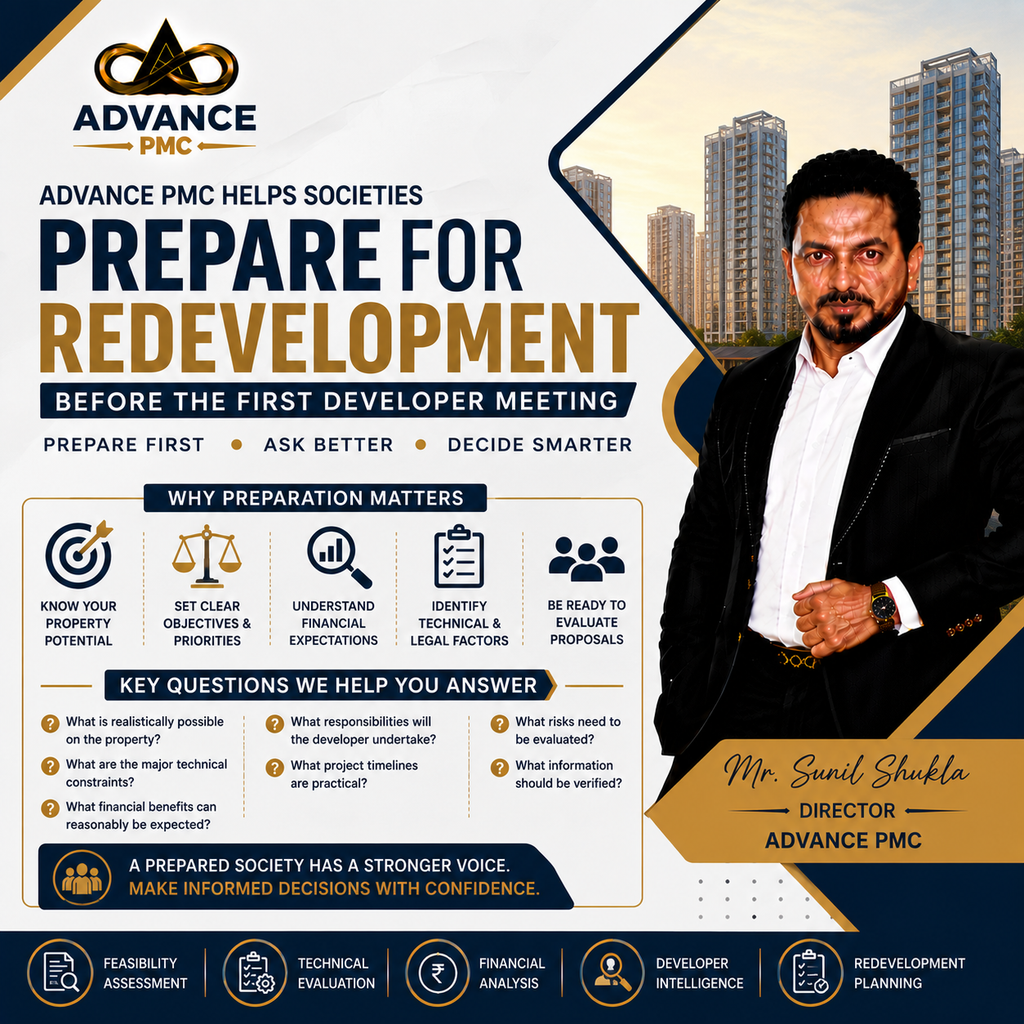
  • Advance PMC Helps Societies Prepare for Redevelopment Before the First Developer Meeting

    The first meeting with a prospective developer can influence the direction of a redevelopment discussion. However, societies should ideally prepare before entering that meeting.

    Preparation creates confidence.

    Advance PMC helps housing societies organize their redevelopment requirements before discussions with developers begin. This preparation can include understanding property potential, project objectives, technical conditions, financial expectations, documentation, and redevelopment priorities.

    A society that enters discussions without understanding its own position may find it difficult to evaluate proposals objectively.

    Developers may present different possibilities, commercial structures, amenities, timelines, and project concepts. Without an independent understanding of the property’s potential, society representatives may struggle to determine which aspects are realistic.

    Advance PMC provides professional support through feasibility assessment, technical evaluation, financial analysis, developer intelligence, and redevelopment planning.

    Under the leadership of Mr. Sunil Shukla, the company promotes a society-first approach that emphasizes preparation before commitment.

    Preparation also allows committees to establish clear questions.

    What is realistically possible on the property?

    What are the major technical constraints?

    What financial benefits can reasonably be expected?

    What responsibilities will the developer undertake?

    What project timelines are practical?

    What risks need to be evaluated?

    What information should be verified?

    These questions can make developer discussions more productive.

    A prepared society can also compare multiple proposals using consistent criteria instead of allowing each developer presentation to define the discussion.

    This creates a more balanced decision-making process.

    Redevelopment is too important to approach casually. The first developer meeting should be an opportunity to evaluate possibilities—not the moment when a society begins discovering its own requirements.

    Advance PMC believes preparation gives societies a stronger voice.

    When committees understand their property, objectives, and expectations, they can participate in redevelopment discussions with greater clarity and confidence.

    Advance PMC – Prepare First. Ask Better. Decide Smarter.

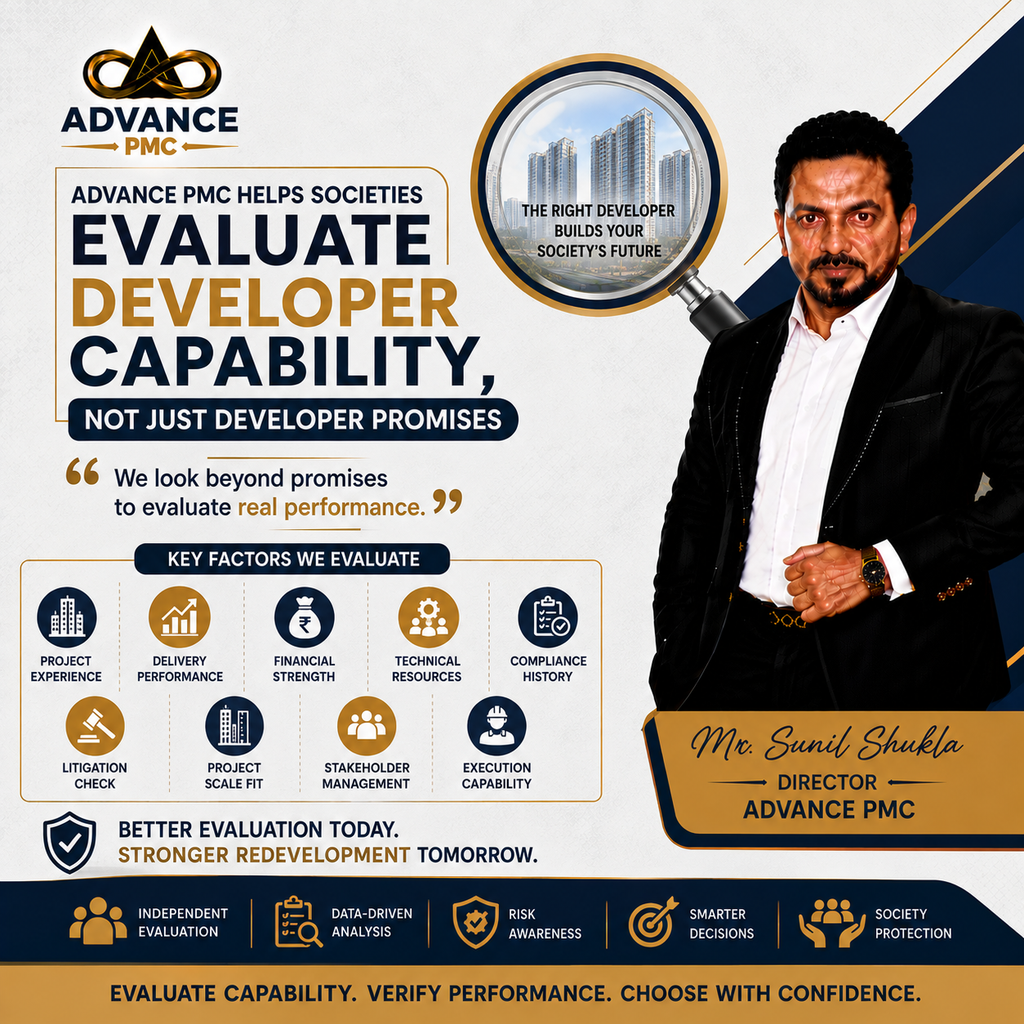
  • Advance PMC Helps Societies Evaluate Developer Capability, Not Just Developer Promises

    Choosing a redevelopment developer should involve more than comparing proposals.

    A developer’s ability to deliver is just as important as what the developer promises.

    Advance PMC helps housing societies evaluate developer capability through a structured and independent approach. The objective is to help committees understand whether a prospective developer has the resources, experience, financial strength, and execution capability required for the specific redevelopment project.

    Different redevelopment projects have different levels of complexity.

    A developer who has successfully completed smaller projects may not automatically be suitable for a large or technically complicated redevelopment. Similarly, market reputation alone does not provide a complete picture of execution capability.

    Societies should consider factors such as previous project experience, delivery performance, financial capability, technical resources, compliance history, litigation-related considerations, project scale, and ability to manage multiple stakeholders.

    Advance PMC’s developer intelligence approach helps societies ask these questions before finalizing an appointment.

    Under the guidance of Mr. Sunil Shukla, the company follows a society-first philosophy that focuses on objective evaluation rather than simply accepting presentations or promises.

    Developer assessment can also help identify differences between marketing claims and practical project capability.

    A strong redevelopment partner should be able to demonstrate not only attractive proposals but also the capacity to execute those commitments.

    Financial capability is particularly important because redevelopment requires significant resources throughout the project lifecycle. Delays in funding or poor financial planning can affect construction progress and project timelines.

    Technical capability is equally relevant.

    A developer needs to coordinate architects, consultants, contractors, approvals, construction activities, and multiple project requirements.

    The ultimate objective of developer evaluation is not to find the developer who makes the biggest promise.

    It is to understand who is best equipped to deliver the promised outcome.

    Advance PMC believes informed developer selection creates a stronger foundation for successful redevelopment.

    Advance PMC – Evaluate Capability. Verify Performance. Choose with Confidence.

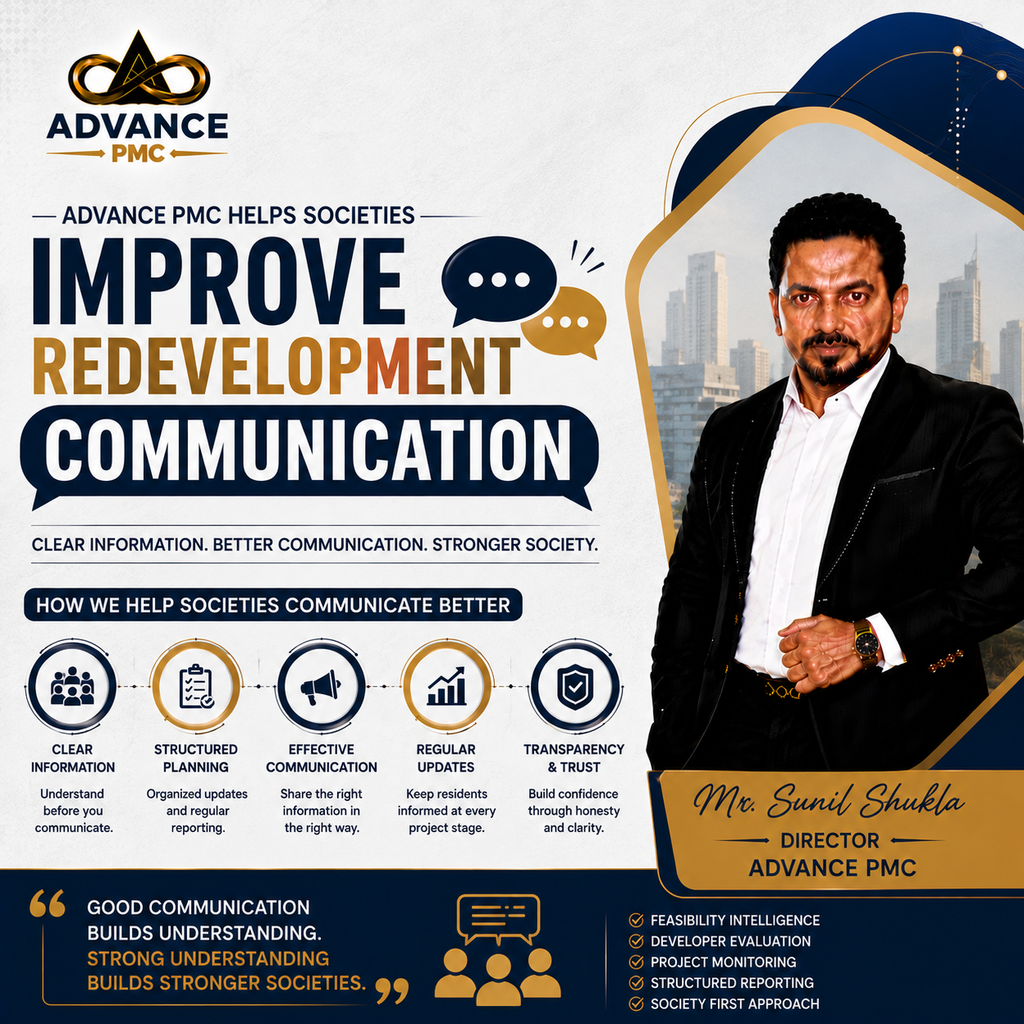
  • Advance PMC Helps Societies Improve Redevelopment Communication

    Redevelopment involves more than technical and financial decisions. It also involves people.

    Residents, committee members, developers, architects, consultants, legal professionals, contractors, and authorities may all participate in different stages of the redevelopment process.

    Without clear communication, even a well-planned project can experience confusion and disagreement.

    Advance PMC helps societies create a more structured approach to redevelopment communication. Professional planning and regular reporting can help committee members understand important developments and communicate relevant information more effectively to residents.

    Clear communication begins with clear information.

    Society representatives should understand the property’s redevelopment potential, project objectives, developer proposals, technical requirements, financial implications, and major project milestones before communicating decisions to members.

    This is where professional redevelopment consultancy can add significant value.

    Advance PMC provides support across feasibility analysis, developer evaluation, technical coordination, financial assessment, project monitoring, and structured reporting.

    Under the leadership of Mr. Sunil Shukla, Advance PMC follows a society-first philosophy where transparency and accountability remain important throughout the redevelopment lifecycle.

    Good communication does not mean sharing every technical detail without context. It means presenting relevant information clearly enough for stakeholders to understand what is happening, why a decision is required, and what the potential implications may be.

    During construction, regular progress updates can also help residents understand project developments and reduce uncertainty.

    Professional monitoring can provide structured information about construction progress, quality, timelines, technical matters, and potential concerns.

    Communication becomes particularly important when challenges arise.

    A society that has established a transparent communication process is often better prepared to discuss problems, evaluate alternatives, and coordinate appropriate action.

    Redevelopment affects people’s homes, investments, and future expectations. That makes communication an essential part of responsible project governance.

    Advance PMC believes professional redevelopment management should not only manage projects—it should help societies remain informed throughout the journey.

    Advance PMC – Clear Information. Better Communication. Stronger Society.