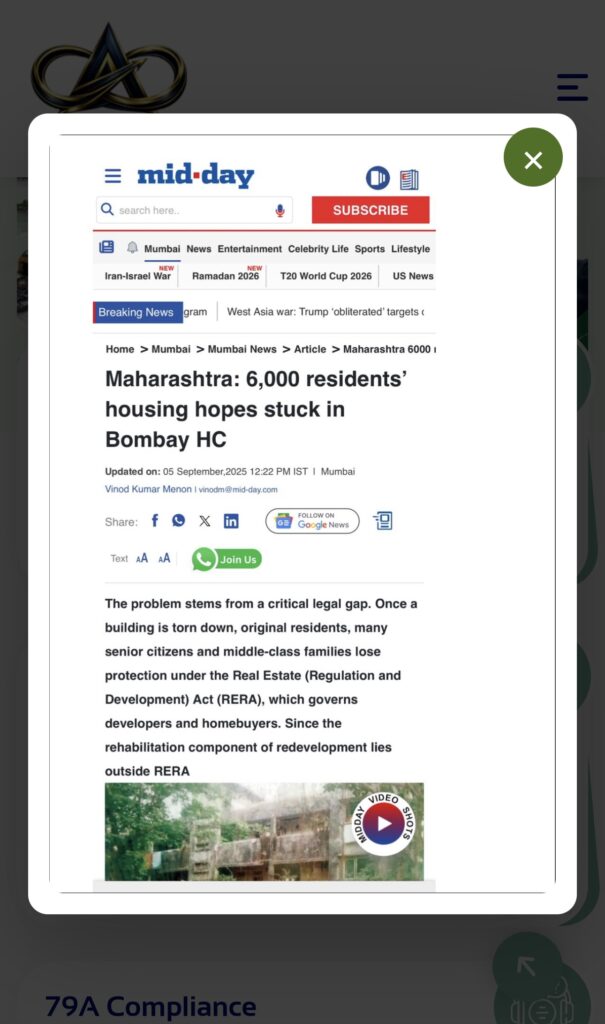
- Your society could be next — if the wrong PMC, weak feasibility, or a badly structured Development Agreement puts your project at risk.
- Advance PMC is not a traditional PMC.
- We are a Redevelopment Risk Intelligence Firm backed by a multidisciplinary council of legal, financial, technical, and market experts — built to protect societies before they make irreversible redevelopment decisions.
- Why committees, chairmen, secretaries, and society members must pause before signing:
- A redevelopment project is not just a construction exercise.
- It is a high-value legal, financial, technical, and strategic transaction involving your home, your land, your rent, your timeline, and your family’s future.
- Once the building is demolished, your bargaining power drops.
- Once the DA is signed, most mistakes become expensive.
- Once delay starts, the society suffers.
- Most societies do not fail during construction.
- They fail before construction even begins.
- The real damage usually starts here:
- Weak or inflated feasibility reports
- Poorly structured tender process
- No developer forensic review
- No escrow discipline
- No proper bank guarantee structure
- No rental inflation protection
- No airtight Development Agreement clauses
- No market intelligence validation
- One individual acting as “PMC” without multidisciplinary capability
- That is how societies get trapped in:
- endless delays
- rent stress
- weak negotiation position
- hidden developer risk
- legal disputes
- financial loss worth crores
- Traditional PMC vs Advance PMC
- A Single Architect Calling Himself PMC Is Not Enough
- Many societies assume they are safe because they appointed a PMC.
- But in reality, most so-called PMCs are often only:
- architect-led
- technically narrow
- process-light
- weak on legal risk
- weak on financial forensic analysis
- weak on funding exposure mapping
- weak on DA protection structuring
- Advance PMC Operates Differently
- We do not work as a single individual.
- We operate through a Council-Based Redevelopment Intelligence Model.
- That means your project is reviewed through:
- legal lens
- financial lens
- technical lens
- market lens
- procedural lens
- risk lens
- This is what supersedes traditional PMC practice.
- The Advance PMC Difference
- Why Advance PMC Is One of the Strongest Options for Redevelopment Protection
- Council-Based Decision Protection
- Not one architect. Not one engineer. Not one consultant with limited scope.
- Advance PMC works through a multidisciplinary council involving experts across redevelopment-critical functions.
- Standard Operating Procedure That Does Not Compromise
- Our process is not casual, verbal, or personality-based.
- It is governed by a structured SOP-led review and protection framework designed to reduce blind spots and stop compromise at critical stages.
- Pre-Tender to Pre-DA Risk Intelligence
- We focus where most damage actually begins:
- before the society signs, surrenders control, or vacates.
- No Surface-Level Feasibility
- We go beyond basic technical feasibility and challenge unrealistic promises, hidden assumptions, and dangerous gaps.
- Society-First Protection Structure
- Every recommendation is built around one question:
- Does this protect the society, its members, and their future rights?
- What Advance PMC Reviews
- Our Intelligence Framework Covers What Others Usually Ignore
- Feasibility Intelligence Report (FIR)
- A deeper redevelopment feasibility review integrating technical, legal, financial, and execution intelligence.
- Developer Risk Intelligence Report (DRI)
- Review of developer strength, track record, group exposure, risk history, and behaviour patterns.
- Market Intelligence Review
- Area demand, supply, pricing, unit movement, surrounding competition, and real-world market validation.
- Development Agreement Risk Review
- Critical clause analysis including:
- escrow structure
- bank guarantee
- step-in rights
- timelines
- compensation protection
- rent safeguards
- financial accountability
- Delay Pattern Behaviour Study
- A deeper view into whether the project is likely to get stuck before the society commits.
- Redevelopment Process SOP Review
- From appointment stage to tender stage to documentation stage, we evaluate whether the process itself is exposing the society.
- Red Flag Checklist
- If These Sound Familiar, Your Society Is Already in the Danger Zone
- Your PMC has not explained rental inflation exposure
- Extra FSI benefit sharing is vaguely worded
- There is no serious developer financial scrutiny
- The DA is being discussed without deep legal protection
- The tender looks generic, rushed, or one-sided
- No one has shown market-based pricing and absorption proof
- Committee is relying on trust instead of structure
- Society members are being pushed to move fast without full intelligence
- You are being told “this is standard practice”
- No one has shown what happens if the developer delays or fails
- If even half of this is true, your project needs immediate review.
Leave a Reply