Category: Advance PMC

  • Most critical risk: Vacating without PAAA in Redevelopment-

    Most Critical Risk: Vacating Without PAAA (Permanent Alternate Accommodation Agreement)

    This is the single biggest mistake societies make in redevelopment.

    The moment members vacate their flats without executing and registering PAAA,
    you don’t just shift out of your home —
    you shift out of your legal control.

    What Really Happens If You Vacate Without PAAA

    1. You Lose Legal Possession Leverage

    Once you hand over possession:
    • You no longer control the asset
    • Your bargaining power drops to zero
    • Developer gains complete physical and strategic control

    At that point, everything depends on “good faith” — not enforceable rights.

    2. Your Rights Become Weak, Delayed, or Disputed

    Without a registered PAAA:
    • Your entitlement to the new flat is not strongly enforceable
    • Carpet area, specifications, and timelines can be disputed
    • You are exposed to interpretation — not protection

    You move from a “secured owner” to a “waiting claimant.”

    3. Timeline Enforcement Becomes Almost Impossible

    Even if delays happen:
    • Penalties are weak or not enforceable
    • Legal recourse becomes long and uncertain
    • You enter the cycle of dispute → delay → litigation

    This is how matters end up in the Bombay High Court
    where societies spend years fighting for what was already theirs.

    4. Rental Protection Gets Compromised

    Without PAAA clarity:
    • Rent continuation terms become vague
    • Delay compensation becomes negotiable
    • Escalation clauses are ignored or diluted

    You may receive rent — but not the rent you deserve.

    5. Developer’s Risk Reduces, Your Risk Multiplies

    Without PAAA:
    • Developer has control of land + structure
    • Funding and execution decisions are in their favor
    • Your dependency increases with every passing month

    You become financially and legally dependent on the developer’s intent.

    The Harsh Reality (What Most Societies Realize Too Late)

    • Once vacated, you cannot “undo” the decision
    • Legal correction after possession is slow and expensive
    • Missing clauses cannot be enforced retrospectively
    • Negotiation power is permanently lost

    This is the exact stage where strong projects turn into long-term disputes.

    What PAAA Actually Secures (When Done Correctly)

    A properly drafted and registered PAAA ensures:

    Defined entitlement – exact carpet area, layout, and rights
    Timeline enforceability – delivery commitments with penalties
    Rental protection – clear payment, escalation, and delay compensation
    Legal enforceability – strong standing in case of dispute
    Security before surrender – you don’t give possession blindly

    Advance PMC Advantage (Where Protection Actually Comes In)

    At Advance PMC, we don’t treat PAAA as a document —
    we treat it as a control mechanism before surrender of your asset.

    We ensure:

    1. PAAA is Executed Before Vacating — No Exceptions

    No member vacates until:
    • PAAA is legally vetted
    • Clauses are non-negotiable
    • Risks are closed

    2. Clause-by-Clause Risk Elimination

    We identify and close:
    • Missing legal protections
    • Weak penalty structures
    • Vague entitlement definitions
    • Developer-friendly loopholes

    3. Integration With Development Agreement (DA)

    PAAA is aligned with DA to ensure:
    • No contradictions
    • No future interpretation gaps
    • Complete legal consistency

    4. Enforcement-Ready Structuring

    Every clause is structured to be:
    • Legally enforceable
    • Financially protective
    • Court-defensible

    5. Pre-Vacating Risk Audit

    Before a single member vacates:
    • Full document audit is completed
    • Exposure points are identified
    • Committee is presented with real risk scenarios

    FOMO Reality (What You Must Ask Yourself Today)

    Before you vacate, ask:

    • “Do we have legal control — or just trust?”
    • “If the project delays by 3 years, are we protected?”
    • “Can we enforce our rights without going to court?”

    If the answer is unclear —
    you are already at risk.

    “Vacating without PAAA is not relocation — it is surrender without protection. Once you move out, you don’t control the project anymore — the document does.”

  • Has your PMC included RENTAL INFLATION COMPENSATION ( RIC) Clause in Tender / Final DA ?

    Rental Inflation Compensation Clause — What It Really Means

    When your society signs a redevelopment deal, the developer agrees to pay monthly rent until possession.

    But here’s the reality:
    Rent today ≠ Rent at the time you vacate.

    There is usually a 1–3 year gap between:

    • Tender finalisation
    • Development Agreement (DA) signing
    • Actual vacating of flats

    During this period, market rent increases significantly — but most agreements freeze rent at old rates.

    The Hidden Loss (Where Societies Lose Crores)

    Example:

    • Rent decided at ₹40,000/month
    • Delay before vacating: 2–3 years
    • Market rent at vacating: ₹55,000–₹65,000

    Who pays the difference?
    → In most cases: YOU (the society members)

    What Happens Without This Clause

    • You receive outdated rent
    • You pay the difference from your own pocket
    • Developer benefits from delay
    • Your financial planning collapses

    This is not a small gap — across 50–100 members, this becomes a crore-level loss.

    What This Clause Must Protect

    A properly drafted Rental Inflation Compensation Clause ensures:

    1. Rent Reset at Time of Vacating

    Rent should NOT be fixed at tender stage.
    It must be revised based on prevailing market rate at actual vacating date.

    1. Pre-Defined Escalation Formula

    Minimum 8%–10% annual escalation OR
    Link to actual market benchmark (leave & license data / ready reckoner zones)

    1. Backdated Compensation

    If delay occurs before vacating,
    → Developer must pay the difference retrospectively

    1. Delay = Developer Liability

    Any delay between:

    • DA signing → Vacating
    • Vacating → Construction

    → Rent increase burden must be fully borne by developer

    1. Lock-in Protection

    Rent once revised must continue increasing annually
    → Not reset or renegotiated later

    Why This Clause is Critical (Hard Truth)

    Most PMCs:

    • Ignore this completely OR
    • Keep a generic escalation clause (which is useless)

    Developers:

    • Intentionally avoid this clause
    • Benefit from delays
    • Save crores at your cost

    Advance PMC View (Straight Reality)

    If your agreement does NOT have a Rental Inflation Compensation Clause:

    → You are already financially exposed
    → Your rent will not match market reality
    → You will subsidise the developer’s delay

    “If your rent is fixed today but your vacating happens after 2–3 years — you are already losing money. The question is not whether there will be a loss, but how big the loss will be.”

  • 6,000+ residents’ housing hopes stuck in Bombay HC.

    • Your society could be next — if the wrong PMC, weak feasibility, or a badly structured Development Agreement puts your project at risk.
    • Advance PMC is not a traditional PMC.
    • We are a Redevelopment Risk Intelligence Firm backed by a multidisciplinary council of legal, financial, technical, and market experts — built to protect societies before they make irreversible redevelopment decisions.
    • Why committees, chairmen, secretaries, and society members must pause before signing:
    • A redevelopment project is not just a construction exercise.
    • It is a high-value legal, financial, technical, and strategic transaction involving your home, your land, your rent, your timeline, and your family’s future.
    • Once the building is demolished, your bargaining power drops.
    • Once the DA is signed, most mistakes become expensive.
    • Once delay starts, the society suffers.
    • Most societies do not fail during construction.
    • They fail before construction even begins.
    • The real damage usually starts here:
    • Weak or inflated feasibility reports
    • Poorly structured tender process
    • No developer forensic review
    • No escrow discipline
    • No proper bank guarantee structure
    • No rental inflation protection
    • No airtight Development Agreement clauses
    • No market intelligence validation
    • One individual acting as “PMC” without multidisciplinary capability
    • That is how societies get trapped in:
    • endless delays
    • rent stress
    • weak negotiation position
    • hidden developer risk
    • legal disputes
    • financial loss worth crores
    • Traditional PMC vs Advance PMC
    • A Single Architect Calling Himself PMC Is Not Enough
    • Many societies assume they are safe because they appointed a PMC.
    • But in reality, most so-called PMCs are often only:
    • architect-led
    • technically narrow
    • process-light
    • weak on legal risk
    • weak on financial forensic analysis
    • weak on funding exposure mapping
    • weak on DA protection structuring
    • Advance PMC Operates Differently
    • We do not work as a single individual.
    • We operate through a Council-Based Redevelopment Intelligence Model.
    • That means your project is reviewed through:
    • legal lens
    • financial lens
    • technical lens
    • market lens
    • procedural lens
    • risk lens
    • This is what supersedes traditional PMC practice.
    • The Advance PMC Difference
    • Why Advance PMC Is One of the Strongest Options for Redevelopment Protection
    • Council-Based Decision Protection
    • Not one architect. Not one engineer. Not one consultant with limited scope.
    • Advance PMC works through a multidisciplinary council involving experts across redevelopment-critical functions.
    • Standard Operating Procedure That Does Not Compromise
    • Our process is not casual, verbal, or personality-based.
    • It is governed by a structured SOP-led review and protection framework designed to reduce blind spots and stop compromise at critical stages.
    • Pre-Tender to Pre-DA Risk Intelligence
    • We focus where most damage actually begins:
    • before the society signs, surrenders control, or vacates.
    • No Surface-Level Feasibility
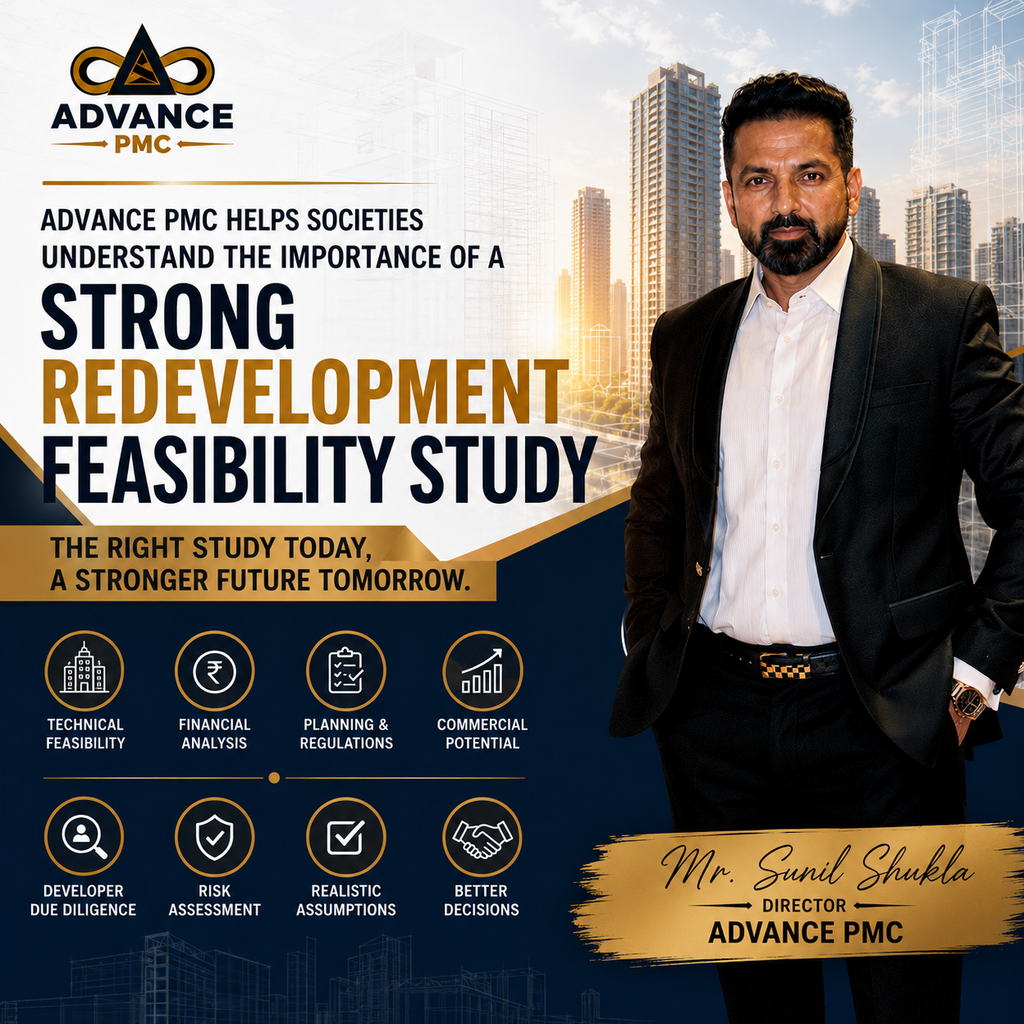
    • We go beyond basic technical feasibility and challenge unrealistic promises, hidden assumptions, and dangerous gaps.
    • Society-First Protection Structure
    • Every recommendation is built around one question:
    • Does this protect the society, its members, and their future rights?
    • What Advance PMC Reviews
    • Our Intelligence Framework Covers What Others Usually Ignore
    • Feasibility Intelligence Report (FIR)
    • A deeper redevelopment feasibility review integrating technical, legal, financial, and execution intelligence.
    • Developer Risk Intelligence Report (DRI)
    • Review of developer strength, track record, group exposure, risk history, and behaviour patterns.
    • Market Intelligence Review
    • Area demand, supply, pricing, unit movement, surrounding competition, and real-world market validation.
    • Development Agreement Risk Review
    • Critical clause analysis including:
    • escrow structure
    • bank guarantee
    • step-in rights
    • timelines
    • compensation protection
    • rent safeguards
    • financial accountability
    • Delay Pattern Behaviour Study
    • A deeper view into whether the project is likely to get stuck before the society commits.
    • Redevelopment Process SOP Review
    • From appointment stage to tender stage to documentation stage, we evaluate whether the process itself is exposing the society.
    • Red Flag Checklist
    • If These Sound Familiar, Your Society Is Already in the Danger Zone
    • Your PMC has not explained rental inflation exposure
    • Extra FSI benefit sharing is vaguely worded
    • There is no serious developer financial scrutiny
    • The DA is being discussed without deep legal protection
    • The tender looks generic, rushed, or one-sided
    • No one has shown market-based pricing and absorption proof
    • Committee is relying on trust instead of structure
    • Society members are being pushed to move fast without full intelligence
    • You are being told “this is standard practice”
    • No one has shown what happens if the developer delays or fails
    • If even half of this is true, your project needs immediate review.

  • Take a Second Opinion Before It’s Too Late

    In redevelopment, one wrong decision can cost a society years of delay, crores in hidden losses, and endless legal disputes. Most housing societies believe the biggest risk begins after construction starts. The truth is far more dangerous: the biggest mistakes are often made much earlier — during the Pre-Tender and Pre-DA stages.

    By the time a society realizes that something is wrong, it is often already trapped.

    A weak feasibility review, incomplete tender understanding, poor developer evaluation, hidden legal gaps, unrealistic promises, manipulated projections, or missing protections in early-stage decision-making can push an entire redevelopment project into uncertainty. What looks attractive on paper can later become the reason for stalled work, member disputes, rental stress, financial burden, and years of regret.

    That is exactly why Advance PMC urges every society, committee member, and flat owner to take a second opinion before it is too late.

    Redevelopment Does Not Fail Suddenly

    It fails silently in the beginning.

    Most redevelopment disputes do not start on the construction site. They start in boardrooms, meetings, assumptions, and documents that members do not fully question. A society may think it is moving fast, but speed without scrutiny is often the first sign of danger.

    When members are rushed into decisions without a full risk review, the consequences can be severe:

    • hidden legal exposure
    • poor tender structuring
    • vague obligations and protections
    • delay-prone planning
    • internal member conflict
    • future litigation and loss of confidence

    A single missed red flag before signing can create years of damage after signing.

    Why a Second Opinion Is No Longer Optional

    Redevelopment is a once-in-a-lifetime decision for most families. It affects homes, financial security, rental stability, title clarity, timelines, and the future value of every member’s asset.

    Yet many societies still move forward without an independent intelligence-based review.

    That is dangerous.

    A second opinion is not about creating fear. It is about exposing the fear that already exists inside a weak process. It is about identifying what others may have ignored, overlooked, or failed to investigate. It is about protecting every member before the society enters into commitments that are difficult, expensive, or impossible to reverse.

    What Advance PMC Delivers

    Advance PMC delivers a complete Risk Intelligence Report from Pre-Tender to Pre-DA — designed to protect societies before final decisions are made.

    This is not a routine report. It is a protection system.

    Our review helps identify:

    • early-stage redevelopment risks
    • gaps in tender understanding and project structure
    • legal and commercial concerns before escalation
    • hidden cost and delay triggers
    • decision-making blind spots that may harm the society later

    The objective is simple: protect every member from preventable loss, preventable delay, and preventable dispute.

    The Cost of Ignoring Risk

    Many societies think they are saving time by skipping a deeper review.

    In reality, they may be inviting:

    • years of project delay
    • rising rental burden
    • member dissatisfaction and mistrust
    • costly disputes
    • weak negotiation position
    • irreversible documentation mistakes
    • project uncertainty that affects every family involved

    By the time the damage becomes visible, the society is no longer choosing from a position of strength. It is reacting from a position of weakness.

    That is when redevelopment becomes painful.

    Get the Full Picture Before You Commit

    Before a society moves ahead, every member deserves clarity.

    Not assumptions.
    Not pressure.
    Not incomplete comfort.
    Clarity.

    Advance PMC helps societies see the full picture before they commit. Our approach is built to bring risk to the surface before it becomes a crisis.

    Because in redevelopment, what you fail to question early may become what you suffer through later.

    Final Word

    Do not wait for delays to start.
    Do not wait for disputes to begin.
    Do not wait for members to panic.
    Do not wait until your society is already locked into a bad decision.

    Take a second opinion before it is too late.

    Advance PMC helps protect your redevelopment journey with a complete Risk Intelligence Report from Pre-Tender to Pre-DA — so your society can move forward with greater clarity, stronger protection, and fewer regrets.

    Advance PMC®
    Protecting every member before final decisions.

  • Is Your Society Going for Redevelopment?

    Is Your Society Going for Redevelopment?

    Has your society already appointed a PMC?

    Has your society already appointed a PMC? Take a second opinion before it’s too late. Advance PMC delivers a complete risk intelligence report (Pre-Tender to Pre-DA) to prevent losses, delays, and legal disputes—protecting every member before final decisions