Redevelopment begins with an important question: What is actually possible on the society’s property?
Before discussions move toward developer selection, commercial negotiations, or major commitments, societies need a realistic understanding of their property’s redevelopment potential.
A feasibility study can provide this foundation.
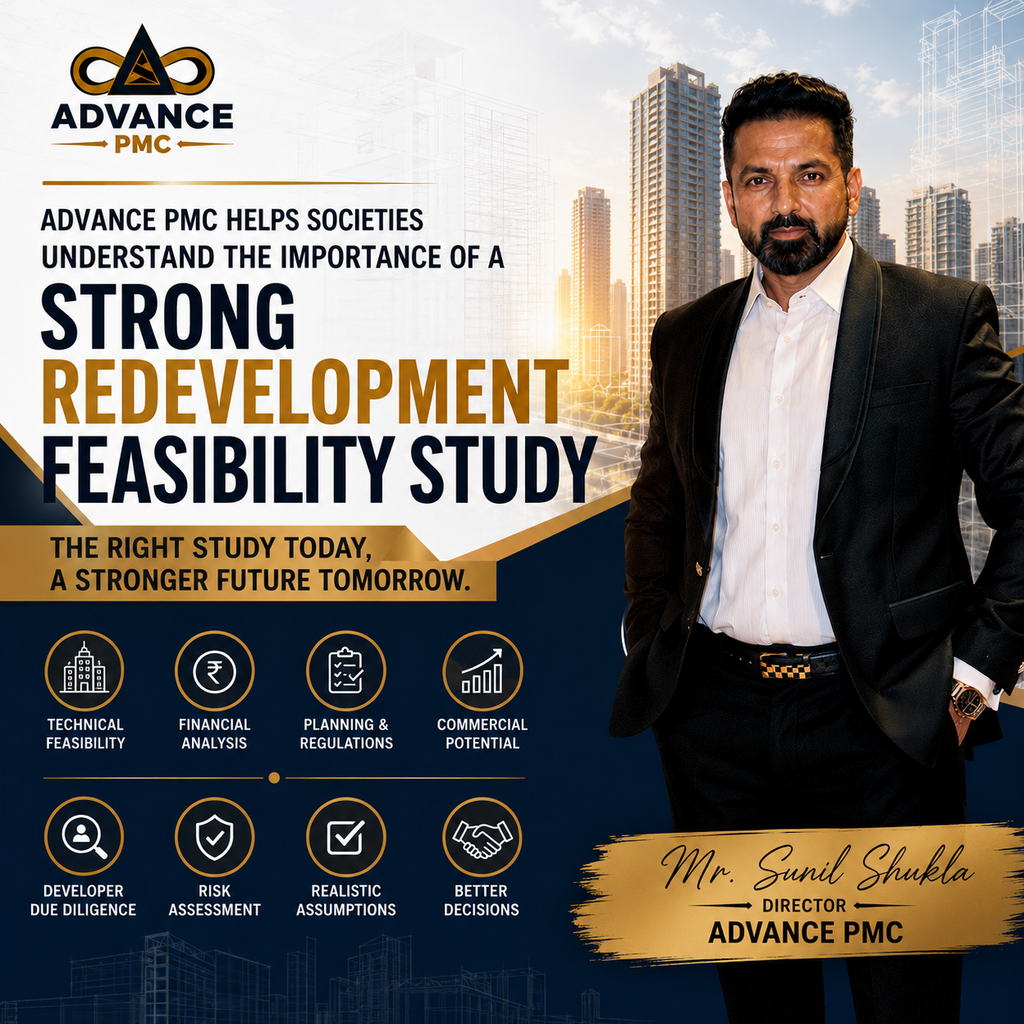
Advance PMC helps housing societies examine redevelopment feasibility through a structured assessment of technical, financial, planning, commercial, and project-related factors.
A property may appear suitable for redevelopment, but the actual possibilities can depend on several conditions.
Site characteristics, plot dimensions, existing structures, development regulations, permissible development potential, access, planning considerations, construction requirements, and other technical factors can influence the project’s possibilities.
Financial feasibility is equally important.
A redevelopment concept needs to be evaluated against construction costs, project expenses, funding requirements, market conditions, expected revenues, and proposed benefits to determine whether the overall project structure is practical.
This is where assumptions can become important.
A proposal may include attractive benefits, but those benefits should be examined in relation to the complete project economics.
Developer capability also forms an important part of feasibility.
Even when a project appears financially attractive, the developer must have the financial strength, experience, technical resources, and execution capability required to deliver the proposed outcome.
Advance PMC, under the leadership of Mr. Sunil Shukla, follows a society-first philosophy that encourages committees to understand these factors before making important decisions.
A feasibility study should not simply answer whether redevelopment is possible.
It should help societies understand how it may be possible, what conditions could affect it, what risks may exist, and which assumptions require further verification.
This information can also strengthen future discussions with developers.
Instead of entering meetings with only expectations, society representatives can approach discussions with a clearer understanding of their property’s potential and project requirements.
Feasibility assessment can therefore become the foundation for better developer evaluation, negotiation, planning, and decision-making.
Redevelopment involves long-term consequences. Decisions made without understanding feasibility can create unrealistic expectations later.
Advance PMC believes societies should understand their property’s potential before evaluating what others promise to deliver.
Advance PMC – Understand the Potential. Test the Feasibility. Plan with Confidence.
Leave a Reply