Tag: Sunil Shukla

  • Advance PMC: Why Society Members Need Transparent Redevelopment Progress Updates

    One of the biggest causes of anxiety during redevelopment is uncertainty. Members want to know whether approvals are received, whether construction is progressing and whether possession remains on schedule.

    Advance PMC believes redevelopment monitoring should be transparent, structured and easy for society members to understand. Site progress, approvals, inspections, milestones and delays should be documented instead of communicated only through informal verbal updates.

    Consistent reporting reduces confusion and helps office bearers answer member questions with facts rather than assumptions.
    Transparency creates confidence. A redevelopment project becomes easier to manage when every important milestone is visible, documented and accountable.
  • Advance PMC: Why Construction Milestones Must Be Linked to Your Development Agreement

    A redevelopment project passes through several critical stages—approvals, demolition, commencement, plinth, slabs, finishing, Occupation Certificate and final possession. These milestones should not exist separately from the Development Agreement.

    Advance PMC believes the Development Agreement should clearly define timelines, obligations and accountability against measurable project milestones.

    When milestones are vague, societies may find it difficult to determine whether the project is genuinely on schedule or whether delays are becoming serious.

    The Development Agreement should function as a live project-control document. Advance PMC helps societies connect contractual commitments with actual redevelopment progress.

  • Advance PMC: Why a Developer’s Existing Projects Can Affect Your Redevelopment Timeline

    A developer may present a strong proposal for your society, but that developer could already be committed to several ongoing projects. Those existing obligations can directly influence cash flow, management bandwidth and execution capacity.

    Advance PMC believes societies should understand the developer’s active project portfolio before making a final selection. The number, size, stage and delay status of other developments can reveal how stretched the organisation may already be.

    A developer handling too many simultaneous commitments may face pressure in approvals, construction funding, contractor payments or management attention.

    The redevelopment decision should therefore consider not only what the developer promises your society, but also what the developer is already responsible for elsewhere.

  • Advance PMC: Why Market Intelligence Can Strengthen Your Society’s Rent and Corpus Negotiation

    Rent and corpus should not be decided merely by comparing what neighbouring societies received several years ago. Real estate markets change, rental values change and developer economics change.

    A Market Intelligence Report by Advance PMC studies current developments, prevailing sale rates, rental trends, unit configurations, project competition and demand conditions around the society.

    This information gives the society a stronger factual foundation while negotiating commercial terms. Instead of negotiating on assumptions, members can refer to current local market intelligence.

    A society that understands its surrounding market is better positioned to negotiate realistic and defensible terms. Advance PMC turns local market data into redevelopment negotiation intelligence.

  • Advance PMC: Why Developer Due Diligence Must Go Beyond RERA Registration

    RERA registration is important, but it should never be treated as the complete measure of a developer’s reliability. A registered developer can still face financial pressure, delayed projects, legal disputes or execution challenges.
    Advance PMC recommends evaluating the developer’s complete background, including project history, liabilities, financial obligations, associated entities, approval performance and previous completion timelines.
    The purpose of due diligence is not to reject developers unnecessarily. It is to help societies understand the real risk behind the name, presentation and commercial offer.
    Before handing over valuable society land and members’ homes, societies should ask a deeper question: What does the evidence say about the developer’s ability to complete this redevelopment successfully?.

  • Advance PMC: Why Society Redevelopment Needs Risk Intelligence Before Negotiation Begins

    Most societies begin redevelopment discussions by asking how much extra area, corpus, rent and amenities a developer is willing to offer. But these numbers should come only after understanding the actual redevelopment risk attached to the project.
    Advance PMC believes every society should first evaluate project feasibility, developer capability, market demand, approval risks, financial sustainability and contractual exposure. A strong offer is meaningful only when the project economics and developer strength support it.
    When a society negotiates without risk intelligence, it may unknowingly accept commitments that look attractive but are difficult to deliver. That can later lead to delays, revised terms or disputes.
    The stronger approach is simple: understand the risk first, then negotiate. Advance PMC helps societies make redevelopment decisions with evidence before emotion takes over.

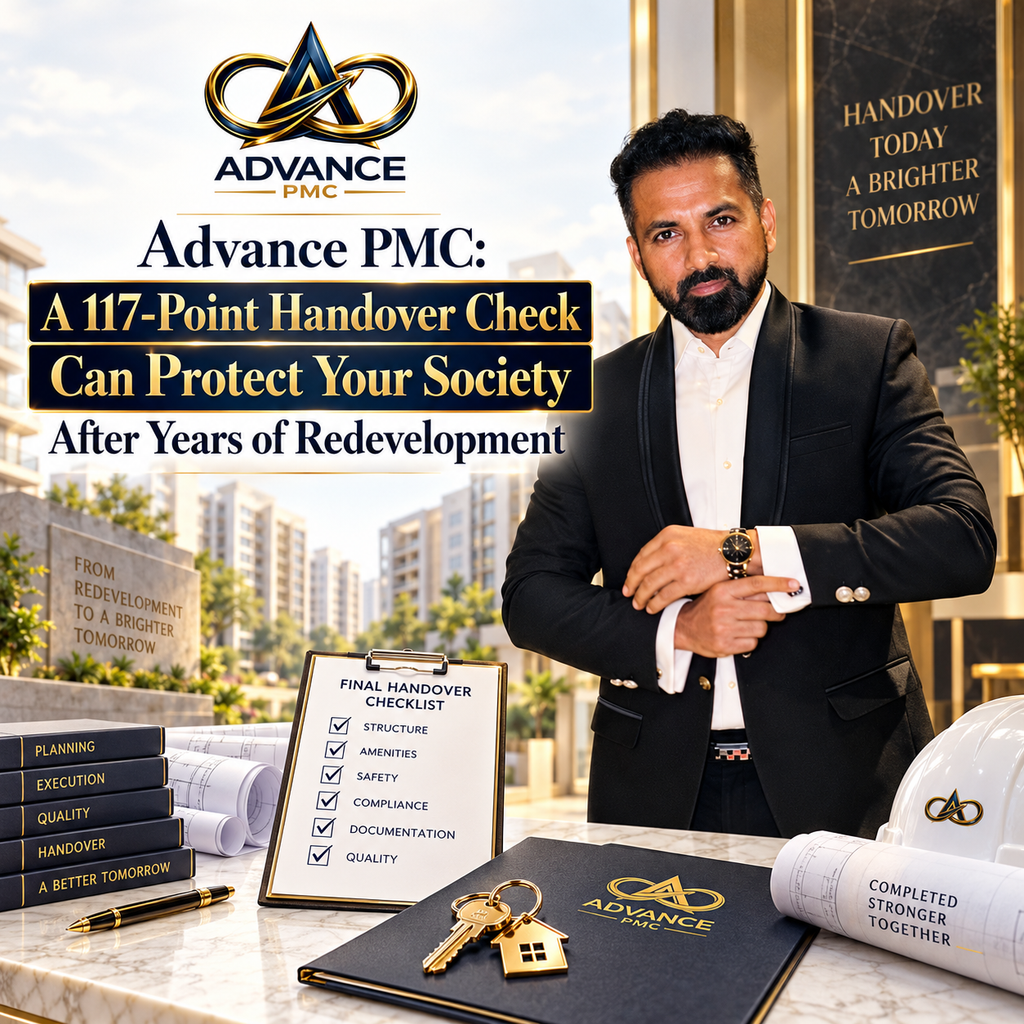
  • Advance PMC: A 117-Point Handover Check Can Protect Your Society After Years of Redevelopment

    After years of redevelopment, members naturally want possession as quickly as possible. But rushing through the final handover can result in defects, incomplete documentation or unfinished obligations being discovered only after the developer’s team has moved on.

    Advance PMC’s detailed handover approach focuses on verifying critical aspects of the completed project before the society closes the redevelopment journey. Structural and common areas, building services, finishing work, amenities, documentation and developer commitments should all be systematically reviewed.

    A checklist creates accountability. Instead of saying that the building “looks complete,” the society can identify specific pending items and maintain a documented record until they are addressed.

    The last stage deserves the same seriousness as developer selection. Years of redevelopment should end with a verified handover—not simply the handing over of keys.

  • Advance PMC: Why Redevelopment Monitoring Should Continue Until the Final Handover

    Selecting the developer and signing the Development Agreement are only the beginning. A redevelopment project moves through multiple approvals, construction stages, inspections, finishing works and ultimately the Occupation Certificate and possession process.

    Advance PMC believes monitoring must continue throughout this journey. Construction progress should be compared with agreed milestones, site inspections should be documented and critical deviations or delays should be identified early.

    As possession approaches, attention must shift toward workmanship, common areas, services, amenities, documentation and outstanding obligations. Small unresolved issues at handover can become difficult and expensive for the society to rectify later.

    Redevelopment success should not be measured when members vacate. It should be measured when members return to a properly completed building with commitments, documents and handover obligations fulfilled.

  • Advance PMC: Vacating Your Building Is a Milestone—Not Just Moving Out

    When members finally vacate their flats for redevelopment, emotions are high and everyone is focused on shifting homes. But from a redevelopment governance perspective, land and building handover is one of the most important milestones in the entire project.

    Advance PMC believes the handover process should be properly documented. Existing conditions, society assets, common areas, meters, documents, keys, fixtures and agreed responsibilities should be recorded rather than handled casually.

    A proper handover record helps establish what was transferred to the developer and under what conditions. This can become important if questions arise later regarding existing assets, obligations or promised reinstatement.

    Before handing over a property built and maintained by generations of members, create a proper documentary trail. Vacating should happen with evidence, acknowledgement and protection—not assumptions.

  • Advance PMC: Why Your Society Should Take a Second Opinion Before Signing the Development Agreement

    By the time a Development Agreement reaches the final signing stage, societies may feel that most major decisions are already complete. But this is precisely when an independent second opinion can become extremely valuable.

    Advance PMC recommends reviewing the project’s technical assumptions, financial commitments, developer risk, market intelligence and critical DA obligations before the society makes its final commitment.

    An independent review can identify questions that may have been overlooked during months of meetings and negotiations. The objective is not to restart the redevelopment process—it is to verify whether the society fully understands the risks it is about to accept.

    Once rights are transferred and members begin vacating, correcting mistakes can become significantly more complicated. A second opinion before signing can cost very little compared with the potential consequences of an overlooked risk.