Transparency becomes increasingly important when a redevelopment project involves multiple stakeholders, significant financial commitments, technical decisions, and long project timelines. Society members need confidence that important information is being properly communicated and that major decisions are being appropriately documented.
Advance PMC supports societies through structured reporting, professional coordination, project monitoring, documentation, technical assessment, and informed decision-making. A transparent process can help committees understand project developments while giving residents a clearer view of important milestones and decisions.
Under the leadership of Mr. Sunil Shukla, Advance PMC maintains a society-first philosophy centered on accountability and clarity. Transparency does not mean sharing every technical detail without context; it means ensuring that important decisions, commitments, developments, and concerns can be properly understood and communicated.
When information flows clearly between the society, professionals, developers, and residents, redevelopment can become more organized and easier to govern. Strong transparency ultimately helps protect trust throughout the project lifecycle.
Redevelopment discussions often focus heavily on immediate benefits such as additional area, corpus, rent, amenities, or other commercial terms. These are important considerations, but a society’s decision can also influence the long-term value, functionality, quality, and usability of its property.
Advance PMC helps societies consider redevelopment from a broader long-term perspective. Technical planning, construction quality, development potential, infrastructure, project execution, future usability, and the sustainability of the proposed project can all contribute to the eventual outcome.
Under the guidance of Mr. Sunil Shukla, Advance PMC follows a society-first philosophy that encourages committees to look beyond immediate gains and consider what the redevelopment could mean for residents over the longer term. The objective is to create a redevelopment strategy that balances present requirements with future expectations.
A successful redevelopment should therefore be evaluated not only by what residents receive at the beginning, but also by the quality and value of what they inherit for years to come.
Many redevelopment concerns do not begin as major problems. They can start with unanswered questions: Who is responsible for a particular activity? What happens if a milestone is delayed? How will a technical change be evaluated? What supports a financial commitment? What happens when project circumstances change?
Advance PMC encourages societies to identify important questions early and seek appropriate professional clarification before decisions become difficult to change. Technical, financial, project-management, and developer-related questions can be examined at the relevant stages of redevelopment.
With Mr. Sunil Shukla at the leadership of Advance PMC, the society-first approach emphasizes preparation, transparency, and accountability. Asking difficult questions before signing major commitments or beginning execution can provide committees with a stronger understanding of potential challenges.
Good redevelopment management is not only about responding when something goes wrong. It is also about creating a process where important questions are identified and addressed before they become larger concerns.
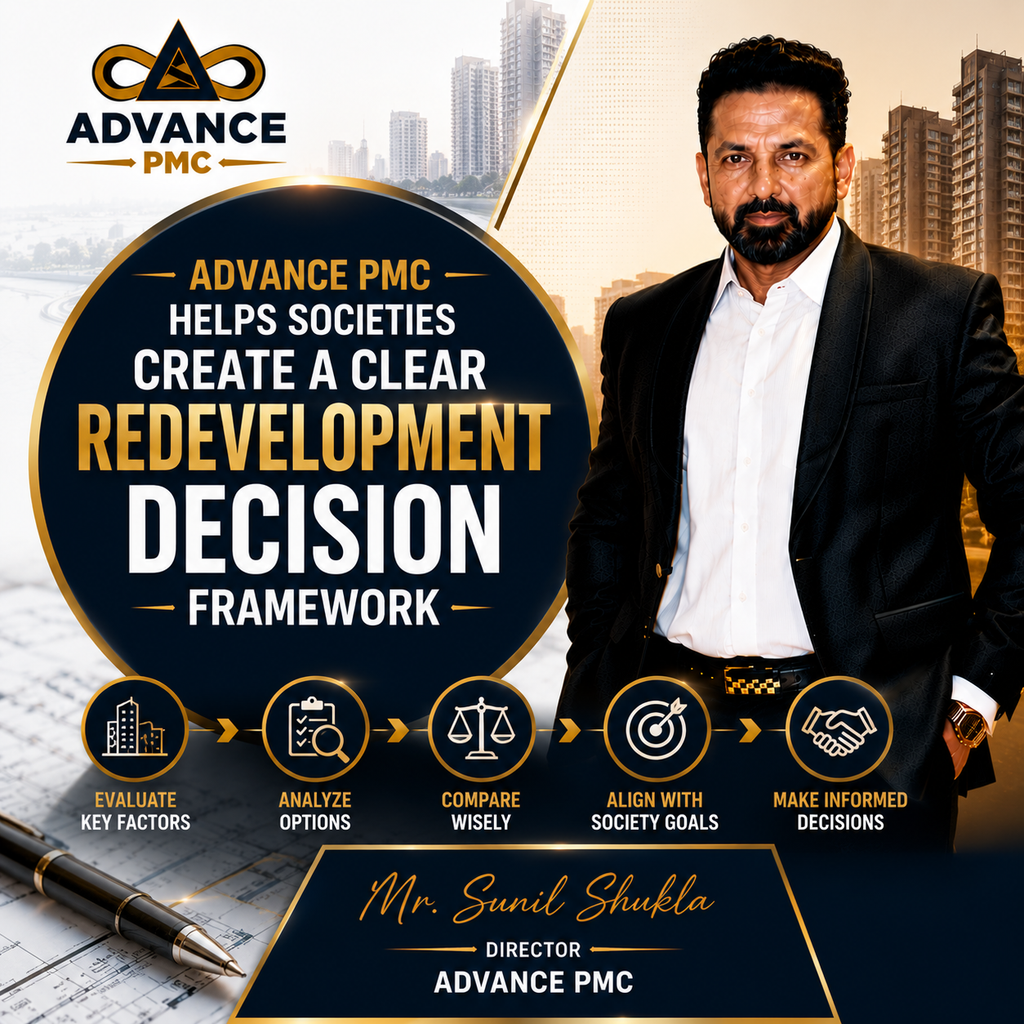
Redevelopment committees often have to evaluate multiple issues at the same time. Developer proposals, financial benefits, technical possibilities, resident expectations, legal considerations, timelines, and project risks can make decision-making complicated. Without a clear framework, important matters may receive unequal attention.
Advance PMC helps societies structure the decision-making process by separating redevelopment into key areas for evaluation. Property potential, feasibility, developer capability, financial structure, technical requirements, project planning, contractual considerations, and execution strategy can each be examined before major decisions are finalized.
Under the leadership of Mr. Sunil Shukla, Advance PMC promotes a society-first philosophy where decisions are based on organized information rather than pressure or isolated benefits. A structured framework can also help committees explain decisions more clearly to society members.
Good decision-making does not necessarily mean choosing the proposal with the most attractive feature. It means understanding the complete picture and determining whether the proposed redevelopment model aligns with the society’s objectives and practical realities.
Not every unknown in redevelopment represents a definite risk. Some matters may simply require additional information, while others may represent genuine project risks that could affect cost, timelines, quality, or delivery. Understanding this difference can improve the quality of redevelopment decision-making.
Advance PMC helps societies examine areas of uncertainty and identify matters that require verification. Technical assumptions, development potential, financial projections, approval requirements, construction timelines, funding arrangements, and developer capabilities may all require different forms of professional assessment.
Mr. Sunil Shukla and Advance PMC emphasize a structured society-first approach where questions are examined before they become larger project concerns. The objective is to distinguish between what is known, what is assumed, what needs verification, and what could potentially create a project risk.
A society does not need to eliminate every uncertainty before proceeding with redevelopment. It needs to understand the important uncertainties and ensure that appropriate professional attention is given to them.
Advance PMC – Identify the Unknown. Understand the Risk. Plan with Clarity.
A housing society may receive information from developers, consultants, architects, contractors, and other professionals during redevelopment. Each stakeholder may provide valuable input, but their roles and interests can be different. This makes independent professional guidance particularly useful when a society is evaluating major decisions.
Advance PMC supports societies by bringing structured redevelopment evaluation across technical, financial, planning, developer, and project-management considerations. Independent assessment can help committees understand proposals from the society’s perspective and identify questions that may require deeper professional examination.
Under the leadership of Mr. Sunil Shukla, Advance PMC follows a society-first approach built around transparency and informed decision-making. The purpose of independent advice is not automatically to reject a developer’s proposal, but to provide another professional perspective before important commitments are made.
When a society has access to independent information and professional evaluation, committee members can participate in discussions with greater confidence and a clearer understanding of the issues involved.
Advance PMC – Independent Thinking for Important Redevelopment Decisions.
Two redevelopment proposals may appear similar at first glance, but their underlying structures can be very different. One may offer more area, another may provide stronger financial benefits, while another may present attractive amenities or faster timelines. Comparing only the headline offer may therefore provide an incomplete picture.
Advance PMC helps societies look beyond individual numbers and examine the broader proposal. Technical feasibility, financial assumptions, developer capability, construction strategy, project timelines, responsibilities, approvals, and execution requirements can all influence the actual value of a proposal.
Under the guidance of Mr. Sunil Shukla, Advance PMC encourages societies to create a structured basis for comparison. Instead of asking only, “Who is offering more?”, committees can also ask, “What supports this offer?”, “Is it technically achievable?”, and “Can the proposed commitments realistically be delivered?”
A meaningful comparison is one where benefits are considered alongside feasibility, risk, capability, and execution. This can help societies move from simply comparing offers to evaluating the complete redevelopment proposition.
Advance PMC – Compare the Complete Proposal. Not Just the Biggest Number.
Redevelopment decisions can have long-term consequences for an entire housing society. Yet important choices are sometimes influenced by presentations, informal discussions, assumptions, or the urgency to move the project forward. A more responsible approach is to base major decisions on relevant information and professional assessment.
Advance PMC helps societies bring an evidence-based approach to redevelopment by examining important aspects such as property potential, technical feasibility, financial considerations, developer capability, project planning, and execution requirements. This allows society representatives to understand the reasoning behind a proposal rather than evaluating it only through attractive promises or headline benefits.
Under the leadership of Mr. Sunil Shukla, Advance PMC follows a society-first philosophy focused on independent evaluation, transparency, and informed decision-making. The objective is not to make decisions for the society, but to help committee members understand the information required to make stronger decisions themselves.
When redevelopment choices are supported by facts, professional analysis, and properly documented information, societies can approach important discussions with greater clarity and confidence.
Redevelopment projects generate a large amount of activity.
Meetings take place, construction progresses, reports are produced, approvals are pursued, and different stakeholders coordinate throughout the project.
But activity alone does not necessarily mean that the project is moving toward its intended outcome.
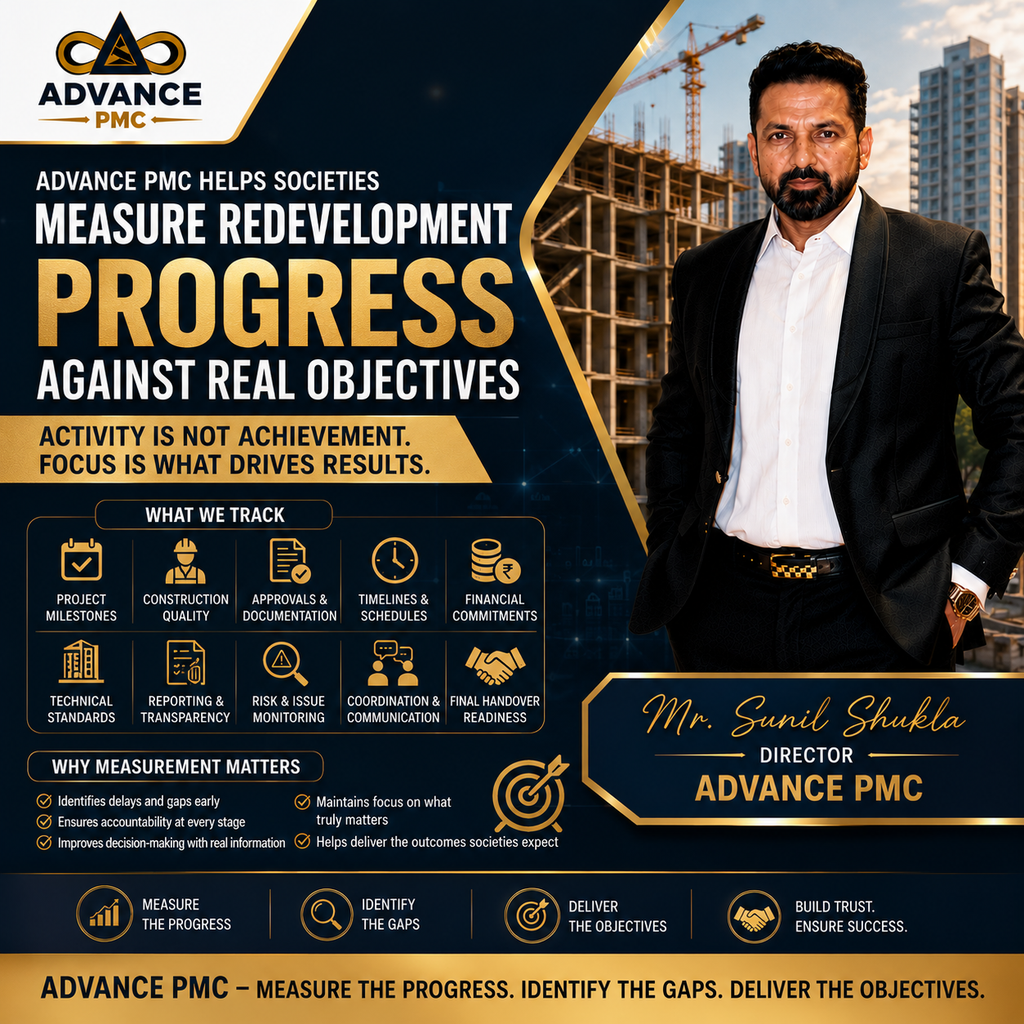
Advance PMC helps societies maintain focus on measurable redevelopment objectives.
Before execution begins, a society should ideally understand what success means for its project.
This may include construction quality, agreed area, amenities, timelines, financial commitments, technical standards, approvals, documentation, and overall project completion requirements.
Once these objectives are established, actual project progress can be evaluated against them.
This creates an important distinction between activity and achievement.
A project may appear busy on site while still experiencing delays in critical milestones.
Similarly, construction may be progressing while certain quality, documentation, approval, or coordination issues remain unresolved.
Professional project monitoring can help society representatives maintain greater visibility over these areas.
Advance PMC supports societies through progress assessment, technical reviews, quality monitoring, structured reporting, and project coordination.
Under the leadership of Mr. Sunil Shukla, Advance PMC follows a society-first approach focused on transparency, accountability, and informed project management.
Regular reporting can help committees understand what has been completed, what is currently underway, what remains pending, and whether any concerns require attention.
This information can support more effective decision-making.
Measurement also allows changes to be identified earlier.
If a milestone is moving behind schedule, the society can investigate the reason and consider the appropriate response.
If construction quality does not match expectations, technical review can help determine the concern and the next steps.
If project objectives are changing, those changes can be documented and evaluated.
Redevelopment should therefore be managed through more than periodic updates.
It requires a structured understanding of where the project stands in relation to what was originally planned and agreed.
The ultimate goal of monitoring is not to interfere unnecessarily with execution.
It is to provide society representatives with sufficient visibility to understand progress and respond responsibly when attention is required.
Advance PMC believes that what gets properly monitored can be better understood, and what is better understood can be managed more effectively.
Advance PMC – Measure the Progress. Identify the Gaps. Deliver the Objectives.
Redevelopment involves commitments that can continue for many years.
Once important commercial, technical, and contractual decisions are finalized, changing them later can become difficult.
This makes safeguards an important part of redevelopment planning.
Advance PMC helps housing societies identify areas where appropriate safeguards may need to be considered before major commitments are made.
Safeguards can relate to several aspects of a redevelopment project.
Timelines, construction quality, financial commitments, temporary accommodation, developer responsibilities, approvals, project milestones, documentation, dispute mechanisms, and handover requirements may all require careful attention.
The objective is not to make redevelopment unnecessarily complicated.
It is to ensure that important expectations are properly understood and supported by appropriate professional and legal advice.
Advance PMC approaches these matters through a combination of redevelopment intelligence, technical evaluation, financial assessment, project planning, and coordination with relevant professionals.
Under the guidance of Mr. Sunil Shukla, the company’s society-first philosophy emphasizes transparency, accountability, and protection of society interests.
A safeguard is most useful when it addresses a realistic project risk.
For example, if project timelines are important to residents, the society should understand how timelines are defined, what milestones are involved, and what mechanisms apply if delays occur.
If construction quality is a major priority, appropriate specifications, inspection processes, technical reviews, and documentation can become important.
If financial commitments are significant, the society should understand the conditions and assumptions associated with those commitments.
The same principle applies to handover.
A project should not be considered complete simply because construction activity has substantially finished. Documentation, approvals, quality verification, agreed deliverables, and other requirements may also need attention.
Professional redevelopment management can help societies identify these areas early.
Legal professionals should provide appropriate advice on contractual protections, while technical and financial professionals can evaluate matters within their respective areas of expertise.
Advance PMC believes strong redevelopment outcomes are supported not only by attractive benefits, but also by thoughtful safeguards designed around the society’s actual requirements.
Advance PMC – Anticipate the Risk. Strengthen the Safeguards. Protect the Society.