Tag: CEO Advance PMC

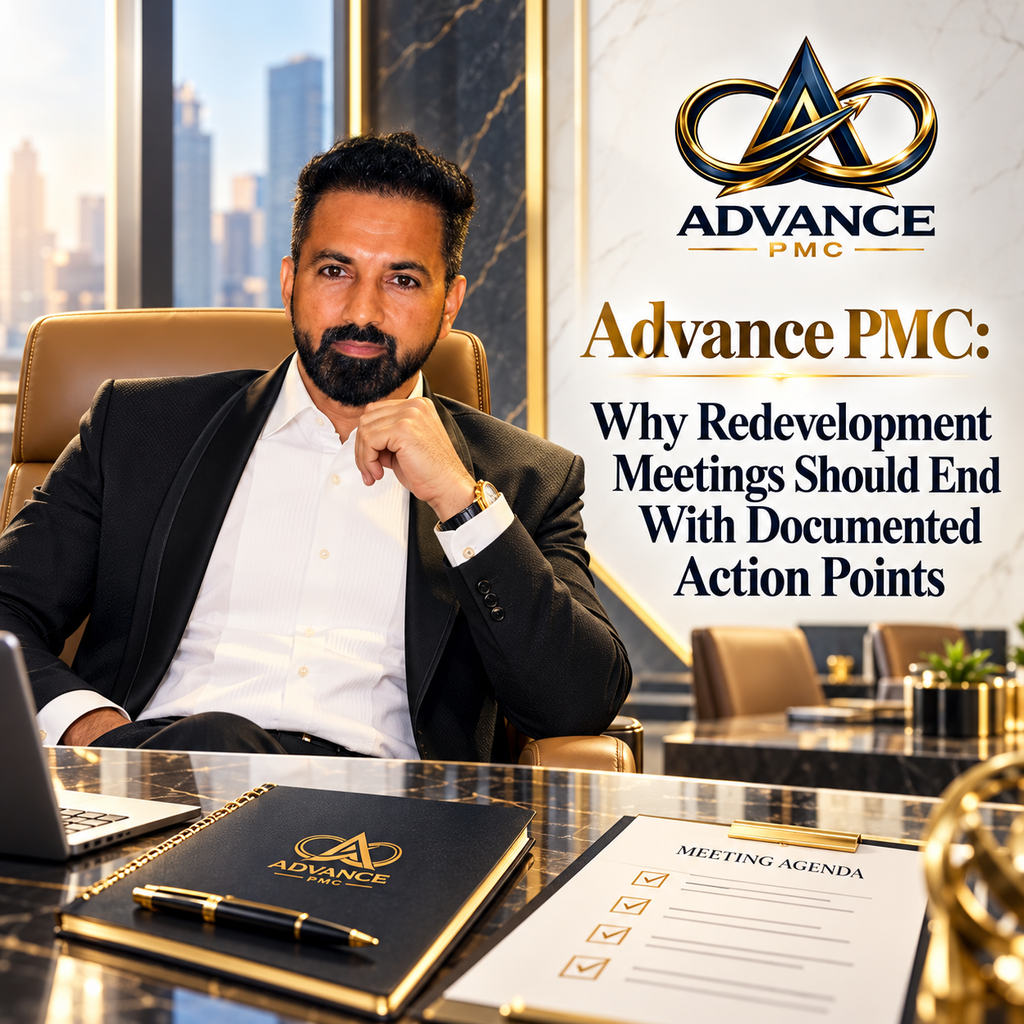
  • Advance PMC: Why Redevelopment Meetings Should End With Documented Action Points

    Society redevelopment meetings often involve lengthy discussions between committee members, consultants, developers and advisers. Problems arise when everyone leaves the meeting with a different understanding of what was decided.

    Advance PMC believes every important meeting should conclude with clearly documented action points, responsibilities and expected completion dates.

    This creates accountability and makes it easier to track whether decisions are actually implemented before the next meeting.

    Good project governance depends on converting discussion into action. Advance PMC helps societies maintain a clear trail from meeting decisions to actual redevelopment progress.

    Practical Checklist After Every Meeting

    Record the key decisions taken.

    Mention each pending action separately.

    Assign a responsible person or organisation.

    Add a target completion date.

    Record documents or approvals to be submitted.

    Circulate the minutes to relevant stakeholders.

    Review pending actions at the next meeting.
  • Advance PMC: Why Societies Should Examine Developer Debt Before Final Selection

    A developer may own several projects and carry a strong market presence, but societies should also understand how much debt sits behind that growth. High borrowing can affect cash flow, lender control and the developer’s ability to fund multiple projects simultaneously.

    Advance PMC believes societies should evaluate relevant borrowings, secured liabilities, project-level financing and repayment obligations before appointing a developer.

    Debt itself is not automatically a negative factor. The real concern is whether repayment commitments are manageable and whether sufficient financial capacity remains available for the society’s redevelopment.

    A redevelopment decision should therefore look beyond brand value and asset size. Advance PMC helps societies understand the financial obligations that may influence future project execution.

    Practical Checklist for the Society

    Check major secured and unsecured borrowings.

    Review ROC charges and lender exposure.

    Understand loans linked to existing projects.

    Check whether important assets are mortgaged.

    Ask whether the developer has adequate liquidity for your project.

    Compare total financial obligations with ongoing project commitments.

  • Advance PMC: Why Redevelopment Committees Need a Decision Register for Major Project Choices

    During redevelopment, committees make hundreds of decisions involving developers, consultants, commercial terms, designs, approvals and contractual matters. Over time, remembering why each decision was taken becomes difficult.

    Advance PMC believes societies should maintain a structured decision register recording major decisions, supporting information, approvals and responsible persons.

    This creates continuity when committee members change and helps the society understand the reasoning behind important project choices.

    Good governance depends on institutional memory. Advance PMC helps societies create a transparent decision trail so redevelopment remains accountable from the first meeting to final handover.

  • Advance PMC: Why a Society Should Verify Whether Developer Commitments Survive Policy Changes

    Redevelopment projects can continue for several years, during which regulations, development control provisions or approval conditions may change.

    Advance PMC believes societies should understand whether important developer commitments are fixed obligations or dependent on future regulatory outcomes.

    If additional area, amenities or financial benefits depend heavily on future policy interpretation, the society should know what happens if those assumptions do not materialise.

    A strong redevelopment agreement should anticipate uncertainty rather than ignore it. Advance PMC helps societies identify which commitments remain protected even when external conditions change.

  • Advance PMC: Why Member Consent Records Must Remain Clear Throughout the Redevelopment Process

    Redevelopment involves several important resolutions and member decisions over many months or years. As negotiations evolve, members need clarity about what has actually been approved and under what terms.

    Advance PMC believes consent records, meeting minutes and resolutions should clearly capture the decisions taken by the society at each important stage.

    Poorly maintained records can create confusion later when members, office bearers or advisers remember discussions differently.

    Transparent decision records protect both the committee and the general body. Advance PMC treats clear member consent documentation as an essential part of redevelopment governance.

  • Advance PMC: Why Redevelopment Insurance Requirements Should Be Reviewed Before Construction Begins

    Construction introduces risks that do not exist while members are still living in the old building. Accidents, property damage, third-party claims and construction-related incidents can create significant exposure.

    Advance PMC believes societies should understand what insurance coverage is proposed during demolition and construction, who is insured and whether the coverage remains valid throughout the relevant project period.

    Insurance documentation should not be treated as a routine checklist item. The society should understand the scope of protection and whether important project risks are appropriately covered.

    Good redevelopment governance prepares for unexpected events before they occur. Advance PMC encourages societies to review risk protection alongside technical and contractual planning.

  • Advance PMC: Why Societies Should Understand the Cost of Delay Before Accepting a Redevelopment Timeline

    A six-month or one-year delay may sound manageable during negotiations, but its financial impact can become substantial across an entire society.

    Advance PMC believes societies should consider additional rent exposure, escalation, maintenance of temporary arrangements, financing implications and the emotional cost of extended displacement.

    When multiplied across dozens of families, even a relatively short delay can create a major financial burden. That is why project timelines should be evaluated alongside the consequences of missing them.

    Time is not merely a scheduling issue in redevelopment—it has a financial value. Advance PMC helps societies understand the true cost of delay before committing to a project structure.

  • Advance PMC: Why Redevelopment Proposals Should Be Compared on Risk-Adjusted Value, Not Headline Numbers

    Two developers may offer different corpus, rent, additional area and amenities. The proposal with the highest number may initially appear superior, but the real value depends on whether those commitments are financially and operationally achievable.

    Advance PMC believes redevelopment offers should be compared after considering developer strength, funding capability, execution history, market conditions, liabilities and contractual protection.

    An offer that is slightly lower but strongly supported by financial capacity and proven execution may ultimately carry less risk than an aggressive offer dependent on optimistic assumptions.

    The best redevelopment proposal is not always the biggest promise. Advance PMC helps societies compare offers on sustainable value rather than headline attraction.

  • Advance PMC: Why Your Society Should Define Who Is Responsible for Every Redevelopment Approval

    Redevelopment approvals involve architects, developers, consultants, government authorities and sometimes multiple specialist agencies. When responsibilities are unclear, delays can easily become someone else’s problem.

    Advance PMC believes every major approval should have a clearly identified responsible party, expected submission date, follow-up process and documented status.

    This helps the society understand whether a delay arises from an authority, incomplete documentation, consultant coordination or developer inaction.

    Clear responsibility creates accountability. Advance PMC helps societies move from “approval is pending” to knowing exactly what is pending, with whom and why.

  • Advance PMC: Why Societies Should Verify the Developer’s Litigation Exposure Before Final Appointment

    A developer may have strong branding, impressive projects and attractive financial offers, but unresolved legal disputes can still affect redevelopment execution. Court cases, lender disputes, title issues or project-related claims may create financial or operational pressure.

    Advance PMC believes societies should understand the developer’s material litigation exposure before completing the selection process. The objective is not simply to count cases, but to understand their nature, financial impact and relevance to ongoing business operations.

    A dispute connected to land, lenders or project obligations can carry very different risk compared with a routine commercial matter. Societies therefore need context, not merely a list of cases.

    Redevelopment involves handing over valuable land and homes. Advance PMC helps societies evaluate whether hidden legal exposure could affect the developer’s ability to fulfil long-term commitments.