Blog

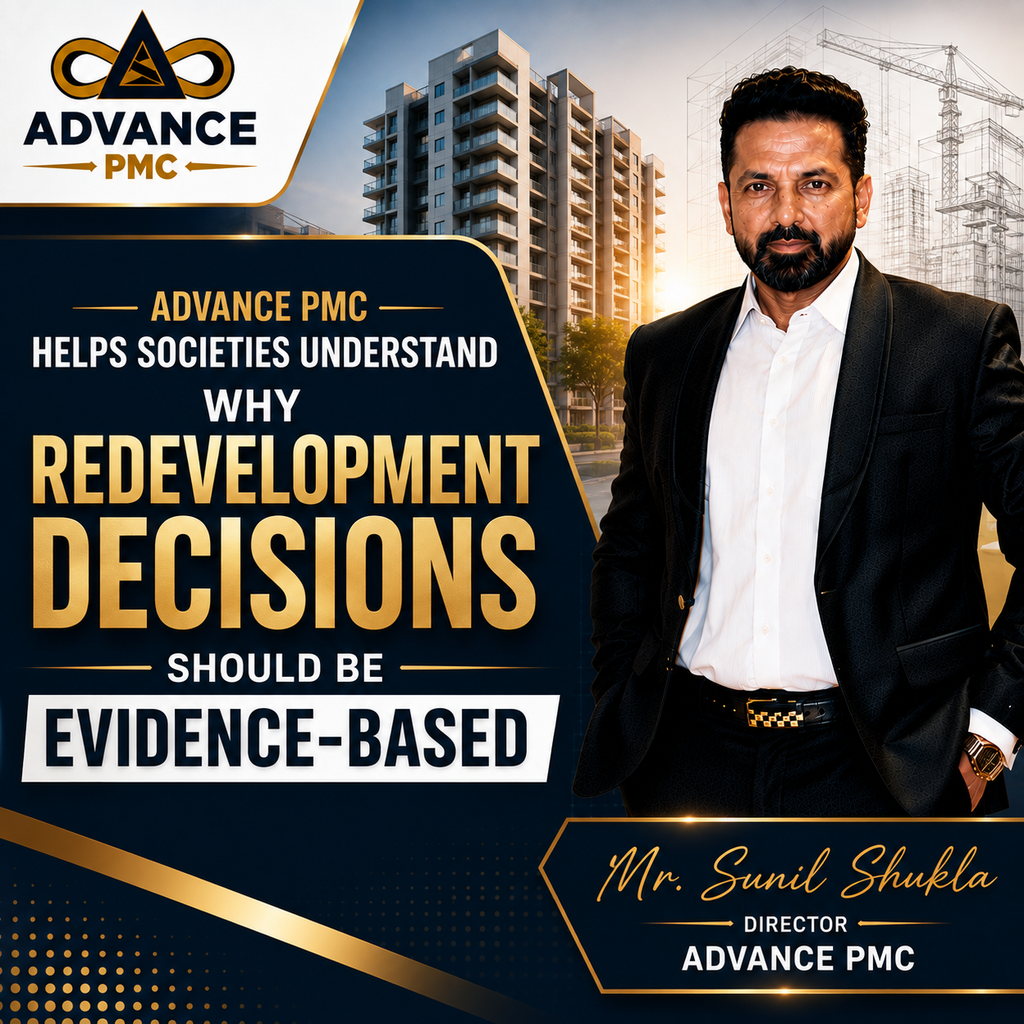
  • Advance PMC Helps Societies Understand Why Redevelopment Decisions Should Be Evidence-Based

    Redevelopment decisions can have long-term consequences for an entire housing society. Yet important choices are sometimes influenced by presentations, informal discussions, assumptions, or the urgency to move the project forward. A more responsible approach is to base major decisions on relevant information and professional assessment.

    Advance PMC helps societies bring an evidence-based approach to redevelopment by examining important aspects such as property potential, technical feasibility, financial considerations, developer capability, project planning, and execution requirements. This allows society representatives to understand the reasoning behind a proposal rather than evaluating it only through attractive promises or headline benefits.

    Under the leadership of Mr. Sunil Shukla, Advance PMC follows a society-first philosophy focused on independent evaluation, transparency, and informed decision-making. The objective is not to make decisions for the society, but to help committee members understand the information required to make stronger decisions themselves.

    When redevelopment choices are supported by facts, professional analysis, and properly documented information, societies can approach important discussions with greater clarity and confidence.

    Advance PMC – Better Information. Better Decisions. Stronger Redevelopment.
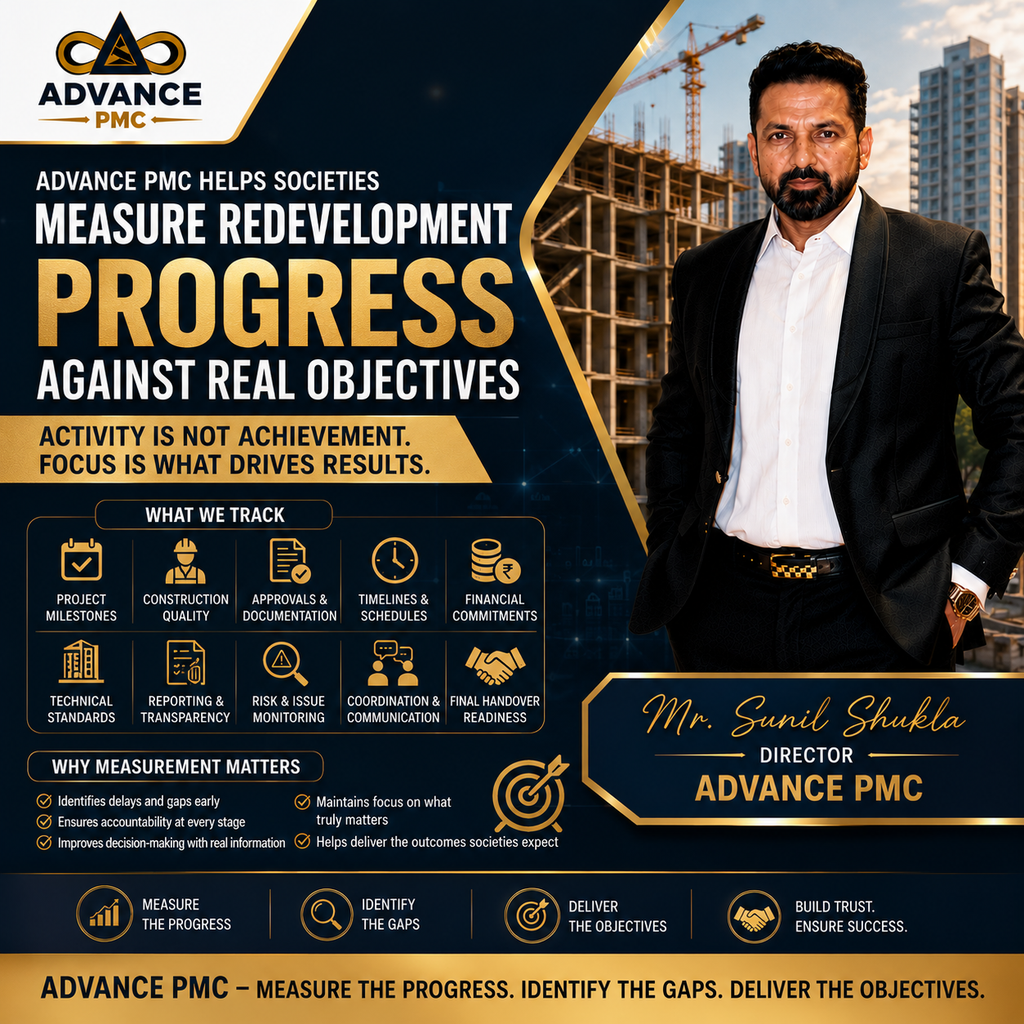
  • Advance PMC Helps Societies Measure Redevelopment Progress Against Real Objectives

    Redevelopment projects generate a large amount of activity.

    Meetings take place, construction progresses, reports are produced, approvals are pursued, and different stakeholders coordinate throughout the project.

    But activity alone does not necessarily mean that the project is moving toward its intended outcome.

    Advance PMC helps societies maintain focus on measurable redevelopment objectives.

    Before execution begins, a society should ideally understand what success means for its project.

    This may include construction quality, agreed area, amenities, timelines, financial commitments, technical standards, approvals, documentation, and overall project completion requirements.

    Once these objectives are established, actual project progress can be evaluated against them.

    This creates an important distinction between activity and achievement.

    A project may appear busy on site while still experiencing delays in critical milestones.

    Similarly, construction may be progressing while certain quality, documentation, approval, or coordination issues remain unresolved.

    Professional project monitoring can help society representatives maintain greater visibility over these areas.

    Advance PMC supports societies through progress assessment, technical reviews, quality monitoring, structured reporting, and project coordination.

    Under the leadership of Mr. Sunil Shukla, Advance PMC follows a society-first approach focused on transparency, accountability, and informed project management.

    Regular reporting can help committees understand what has been completed, what is currently underway, what remains pending, and whether any concerns require attention.

    This information can support more effective decision-making.

    Measurement also allows changes to be identified earlier.

    If a milestone is moving behind schedule, the society can investigate the reason and consider the appropriate response.

    If construction quality does not match expectations, technical review can help determine the concern and the next steps.

    If project objectives are changing, those changes can be documented and evaluated.

    Redevelopment should therefore be managed through more than periodic updates.

    It requires a structured understanding of where the project stands in relation to what was originally planned and agreed.

    The ultimate goal of monitoring is not to interfere unnecessarily with execution.

    It is to provide society representatives with sufficient visibility to understand progress and respond responsibly when attention is required.

    Advance PMC believes that what gets properly monitored can be better understood, and what is better understood can be managed more effectively.

    Advance PMC – Measure the Progress. Identify the Gaps. Deliver the Objectives.

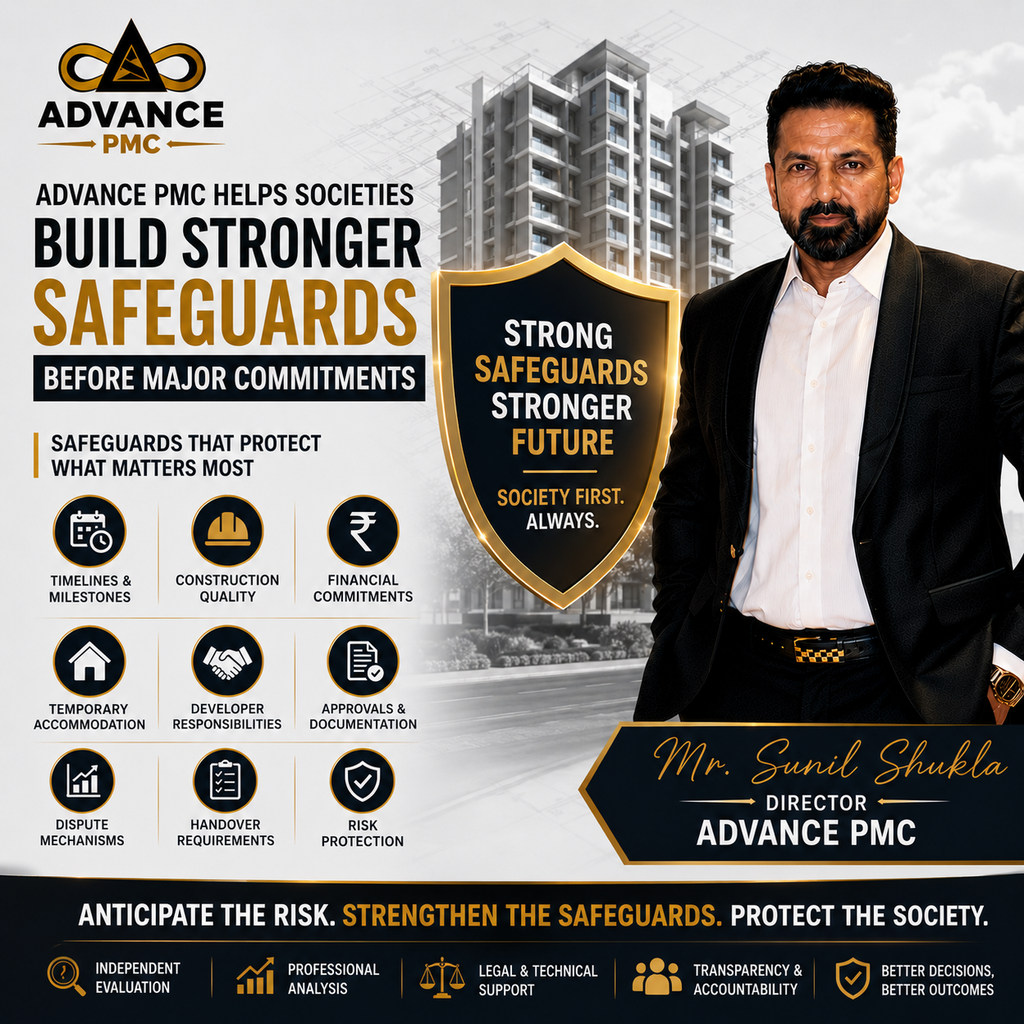
  • Advance PMC Helps Societies Build Stronger Safeguards Before Major Commitments

    Redevelopment involves commitments that can continue for many years.

    Once important commercial, technical, and contractual decisions are finalized, changing them later can become difficult.

    This makes safeguards an important part of redevelopment planning.

    Advance PMC helps housing societies identify areas where appropriate safeguards may need to be considered before major commitments are made.

    Safeguards can relate to several aspects of a redevelopment project.

    Timelines, construction quality, financial commitments, temporary accommodation, developer responsibilities, approvals, project milestones, documentation, dispute mechanisms, and handover requirements may all require careful attention.

    The objective is not to make redevelopment unnecessarily complicated.

    It is to ensure that important expectations are properly understood and supported by appropriate professional and legal advice.

    Advance PMC approaches these matters through a combination of redevelopment intelligence, technical evaluation, financial assessment, project planning, and coordination with relevant professionals.

    Under the guidance of Mr. Sunil Shukla, the company’s society-first philosophy emphasizes transparency, accountability, and protection of society interests.

    A safeguard is most useful when it addresses a realistic project risk.

    For example, if project timelines are important to residents, the society should understand how timelines are defined, what milestones are involved, and what mechanisms apply if delays occur.

    If construction quality is a major priority, appropriate specifications, inspection processes, technical reviews, and documentation can become important.

    If financial commitments are significant, the society should understand the conditions and assumptions associated with those commitments.

    The same principle applies to handover.

    A project should not be considered complete simply because construction activity has substantially finished. Documentation, approvals, quality verification, agreed deliverables, and other requirements may also need attention.

    Professional redevelopment management can help societies identify these areas early.

    Legal professionals should provide appropriate advice on contractual protections, while technical and financial professionals can evaluate matters within their respective areas of expertise.

    Advance PMC believes strong redevelopment outcomes are supported not only by attractive benefits, but also by thoughtful safeguards designed around the society’s actual requirements.

    Advance PMC – Anticipate the Risk. Strengthen the Safeguards. Protect the Society.

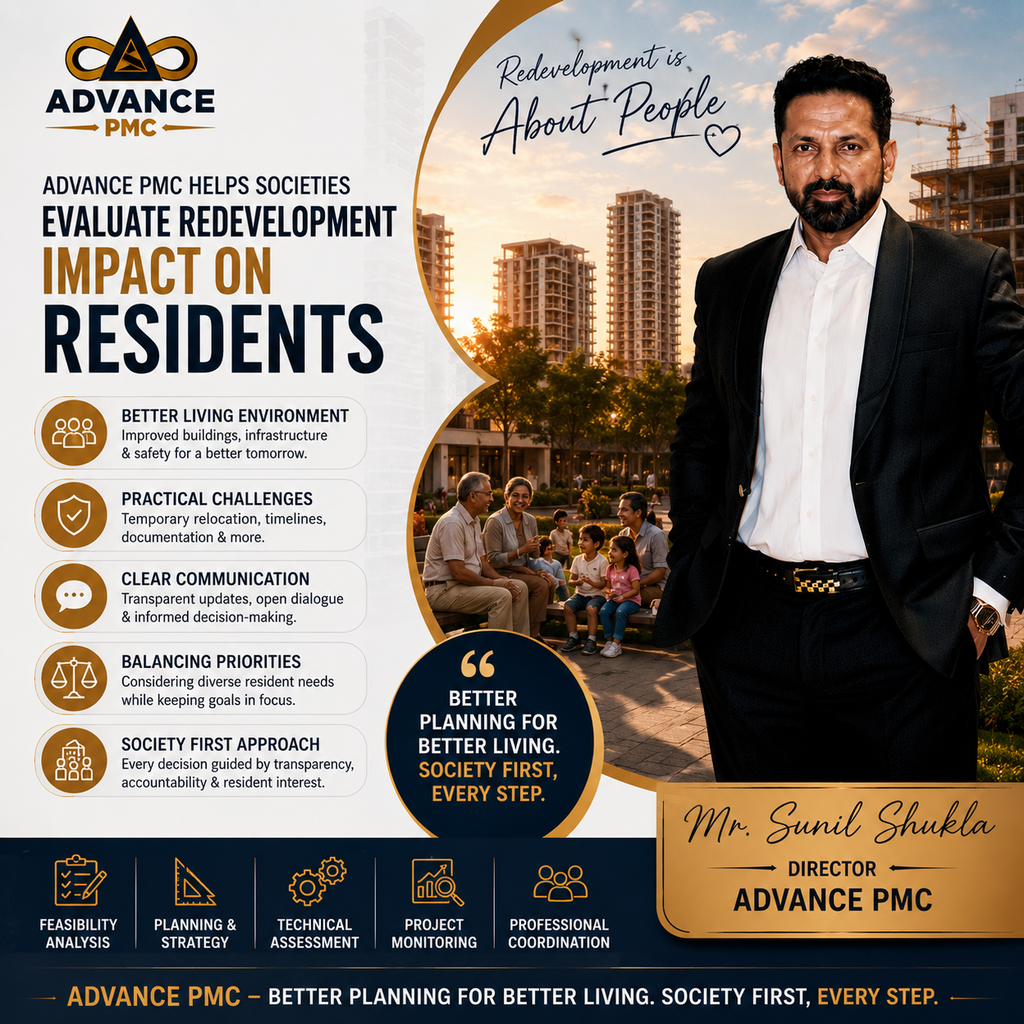
  • Advance PMC Helps Societies Evaluate Redevelopment Impact on Residents

    Redevelopment is ultimately about people.

    Behind every technical report, financial proposal, construction plan, and development agreement are residents whose homes and daily lives are directly affected by the project.

    Advance PMC believes societies should therefore consider resident impact while evaluating redevelopment decisions.

    Redevelopment can bring significant benefits, including improved buildings, better infrastructure, additional amenities, improved safety, and potential financial advantages.

    At the same time, the transition can involve practical challenges.

    Residents may need to consider temporary accommodation, shifting arrangements, communication requirements, timelines, documentation, construction-related expectations, and other aspects of the redevelopment journey.

    These considerations deserve structured attention.

    A society-first approach means understanding the project not only from the developer’s perspective, but also from the perspective of the people who will experience the process.

    Advance PMC helps societies evaluate redevelopment through feasibility analysis, planning, technical assessment, project monitoring, and professional coordination.

    Under the leadership of Mr. Sunil Shukla, the company emphasizes transparency, accountability, and informed decision-making.

    Resident communication is an important part of this process.

    When society members understand the project’s objectives, major milestones, expected changes, and decision-making process, they can participate more meaningfully.

    Clear communication can also help reduce uncertainty.

    During construction, professional monitoring and structured reporting can provide committees with information that can then be communicated appropriately to residents.

    The objective should not be to create unrealistic expectations.

    It should be to provide residents with a realistic understanding of what the redevelopment journey involves.

    Different residents may also have different priorities.

    Some may focus on additional area. Others may prioritize amenities, construction quality, timelines, financial benefits, or long-term property value.

    A well-managed decision-making process can help societies consider these priorities while keeping the overall project objectives in focus.

    Redevelopment is a long-term transformation of the community.

    The success of the project should therefore be measured not only by the completed structure, but also by how effectively the society manages the journey toward that outcome.

    Advance PMC believes that when resident interests remain central to planning and project governance, redevelopment can become a more transparent and meaningful process.

    Advance PMC – Better Planning for Better Living. Society First, Every Step.

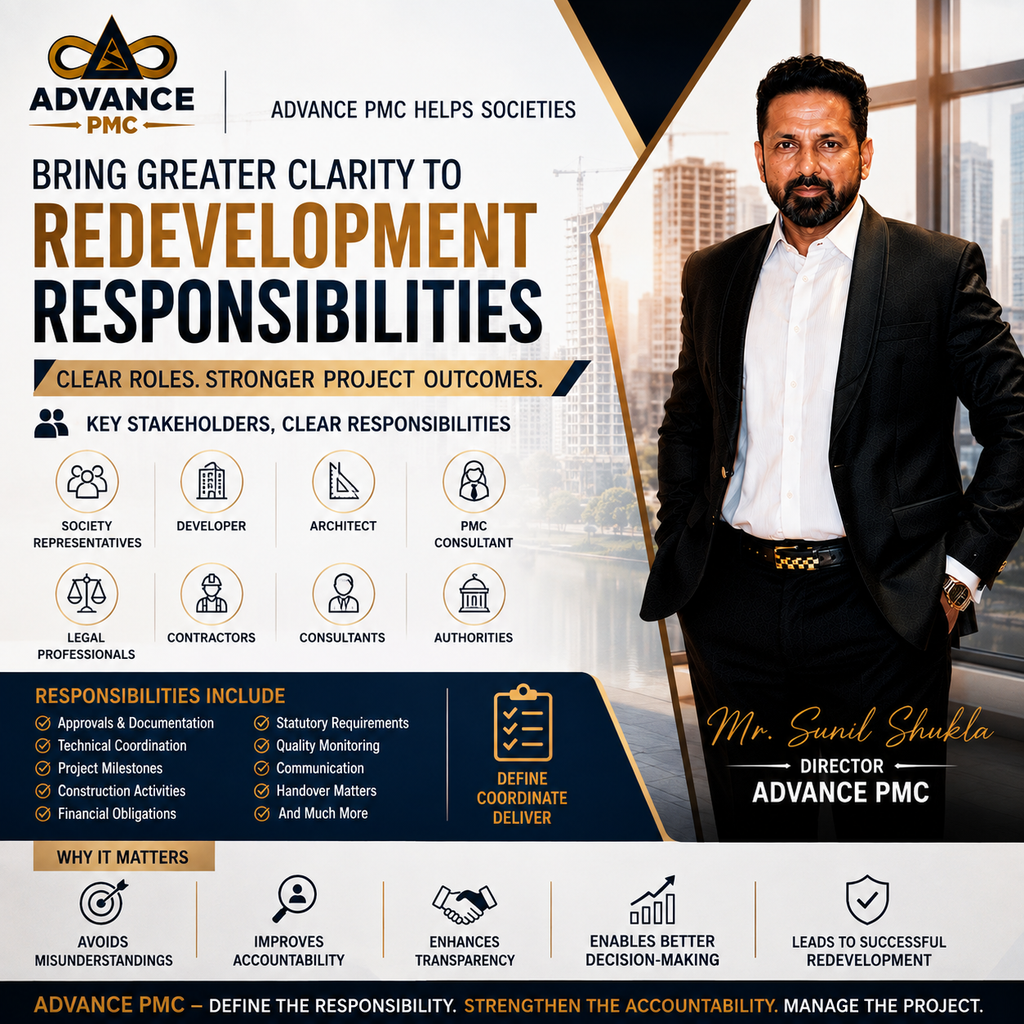
  • Advance PMC Helps Societies Bring Greater Clarity to Redevelopment Responsibilities

    Redevelopment involves many participants.

    The society, developer, architect, project management consultant, legal professionals, contractors, consultants, authorities, and other stakeholders may each have different responsibilities.

    When those responsibilities are unclear, misunderstandings can develop.

    Advance PMC helps societies bring greater clarity to responsibilities throughout the redevelopment lifecycle.

    Responsibility mapping should begin during planning.

    Society representatives need to understand which matters are expected to be handled by the developer and which require action from the society or its appointed professionals.

    This can include approvals, documentation, technical coordination, project milestones, construction activities, financial obligations, statutory requirements, communication, quality monitoring, and handover-related matters.

    Clear responsibilities can make project management more effective.

    When an issue arises, the society can better understand who needs to address it and what information may be required before a decision is taken.

    Advance PMC supports societies through structured project planning, technical coordination, monitoring, reporting, and professional redevelopment management.

    Under the guidance of Mr. Sunil Shukla, the company follows a society-first approach where accountability and transparency remain important throughout the project.

    Responsibility clarity also becomes valuable when project conditions change.

    For example, if a delay occurs, the society should be able to understand the reason, the responsible stakeholders, the impact on the project, and the appropriate response.

    Similarly, when technical concerns arise, clearly defined roles can reduce confusion between developers, consultants, contractors, and society representatives.

    Redevelopment is a collaborative process, but collaboration works best when responsibilities are understood.

    Clear documentation can further strengthen this process by recording commitments, decisions, milestones, and important communications.

    For society committees, this creates greater visibility and helps maintain continuity even when committee members or project stakeholders change.

    Professional project management therefore involves more than monitoring construction.

    It also involves creating a framework where responsibilities, expectations, information, and decisions can be properly coordinated.

    Advance PMC believes that when responsibilities are clearly understood, redevelopment becomes easier to manage and important issues are less likely to fall between stakeholders.

    Advance PMC – Define the Responsibility. Strengthen the Accountability. Manage the Project.

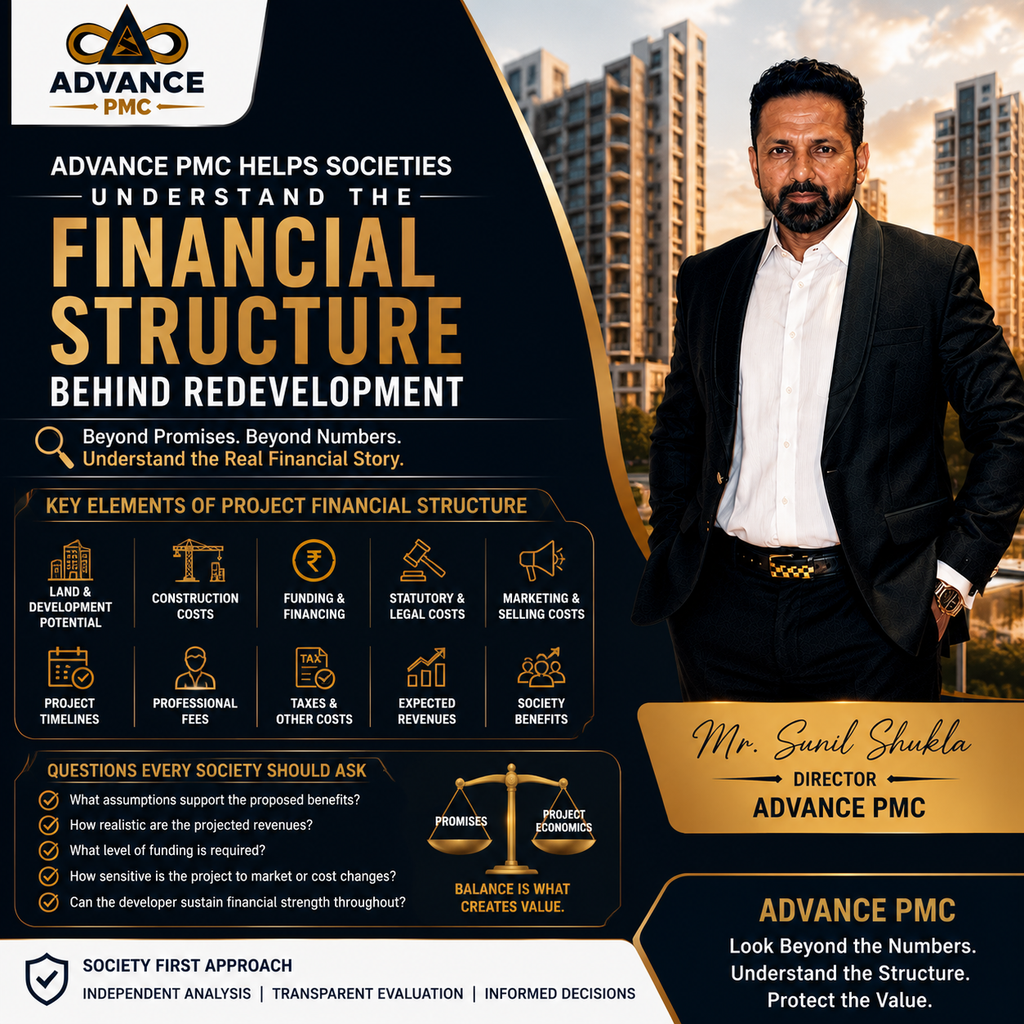
  • Advance PMC Helps Societies Understand the Financial Structure Behind Redevelopment

    Financial benefits are often among the most discussed aspects of redevelopment.

    Corpus, rent, additional area, amenities, commercial arrangements, and other benefits can influence how society members evaluate competing proposals.

    However, looking only at the benefits may not provide a complete understanding of the project’s financial structure.

    Advance PMC helps societies examine redevelopment from a broader financial perspective.

    The objective is not simply to identify the highest financial offer.

    It is to understand whether the overall project economics can support the commitments being proposed.

    Redevelopment involves significant costs.

    Land and development potential, construction expenses, financing requirements, professional fees, statutory costs, marketing considerations, taxes, project timelines, and market conditions can all influence the financial viability of a project.

    A developer’s proposed commitments therefore need to be considered alongside the underlying project economics.

    For societies, this raises several important questions.

    What assumptions support the proposed benefits?

    How realistic are the projected project revenues?

    What level of funding may be required?

    How sensitive is the project to changes in construction costs or market conditions?

    Can the developer maintain financial capacity throughout the project lifecycle?

    These questions can provide a stronger understanding of the proposal.

    Advance PMC combines financial assessment with technical and developer evaluation so that societies can consider the relationship between different project factors.

    Under the leadership of Mr. Sunil Shukla, Advance PMC follows a society-first philosophy focused on professional analysis and informed decision-making.

    Financial evaluation is particularly important because redevelopment is a long-term process.

    A project that appears financially attractive at the beginning may face challenges if its assumptions are unrealistic or if the developer’s financial capacity is insufficient.

    This does not mean that societies should focus only on financial risk.

    Technical feasibility, legal considerations, execution capability, construction quality, timelines, and project governance all contribute to the final outcome.

    The strongest financial proposal is not necessarily the one with the largest number.

    It is the proposal where the commitments, project economics, developer capability, and execution strategy are aligned.

    Advance PMC believes societies deserve to understand the financial story behind the offer before making a long-term redevelopment decision.

    Advance PMC – Look Beyond the Numbers. Understand the Structure. Protect the Value.

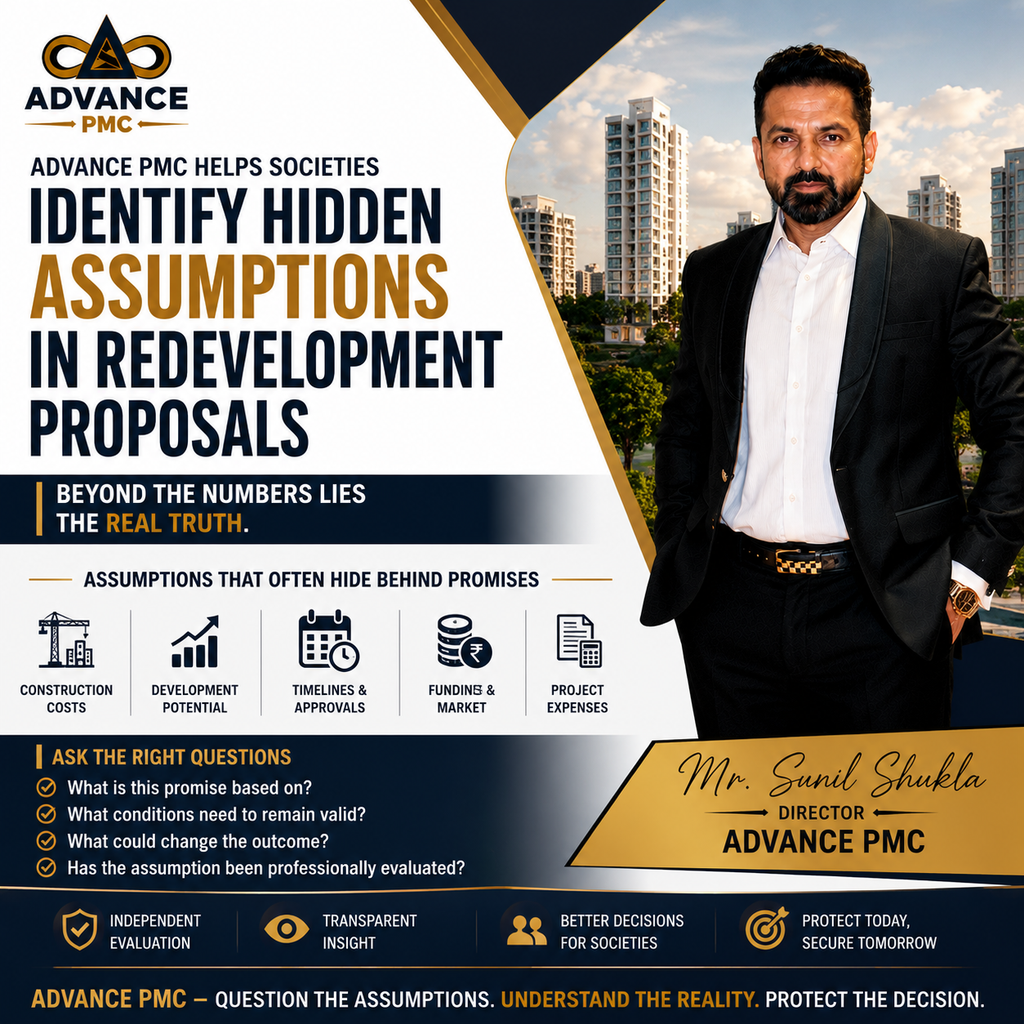
  • Advance PMC Helps Societies Identify Hidden Assumptions in Redevelopment Proposals

    Every redevelopment proposal contains assumptions.

    Some may relate to construction costs. Others may involve development potential, timelines, market conditions, funding, approvals, project expenses, or expected commercial outcomes.

    The challenge is that assumptions are not always visible in the headline numbers presented to a society.

    Advance PMC helps housing societies look beyond the visible offer and identify the assumptions that support it.

    For example, a proposed additional area may depend on technical and planning conditions.

    A promised financial benefit may depend on project economics and market performance.

    A proposed completion timeline may depend on approvals, funding, construction coordination, and execution capability.

    Understanding these connections is important before a society treats a proposal as a firm expectation.

    Advance PMC approaches redevelopment evaluation by examining the broader project proposition.

    Technical feasibility helps societies understand whether the proposed development is realistically achievable.

    Financial assessment can help examine whether the project’s commercial structure appears sustainable.

    Developer due diligence can provide insight into the capability of the party expected to deliver the commitments.

    Project planning can help determine whether proposed timelines and responsibilities are practical.

    Under the guidance of Mr. Sunil Shukla, Advance PMC maintains a society-first approach focused on transparency, independent evaluation, and informed decision-making.

    Identifying assumptions does not mean rejecting a proposal.

    It means asking:

    What is this promise based on?

    What conditions need to remain valid?

    What could change the outcome?

    Has the assumption been professionally evaluated?

    These questions can significantly improve redevelopment discussions.

    A strong proposal should be able to withstand reasonable examination.

    Societies should therefore avoid evaluating redevelopment proposals solely through attractive figures or presentations. The underlying assumptions can be just as important as the benefits being offered.

    Professional redevelopment intelligence helps bring those assumptions into the discussion before they become commitments.

    Advance PMC believes that clarity begins when societies understand not only what is being offered, but what needs to be true for that offer to become reality.

    Advance PMC – Question the Assumptions. Understand the Reality. Protect the Decision.

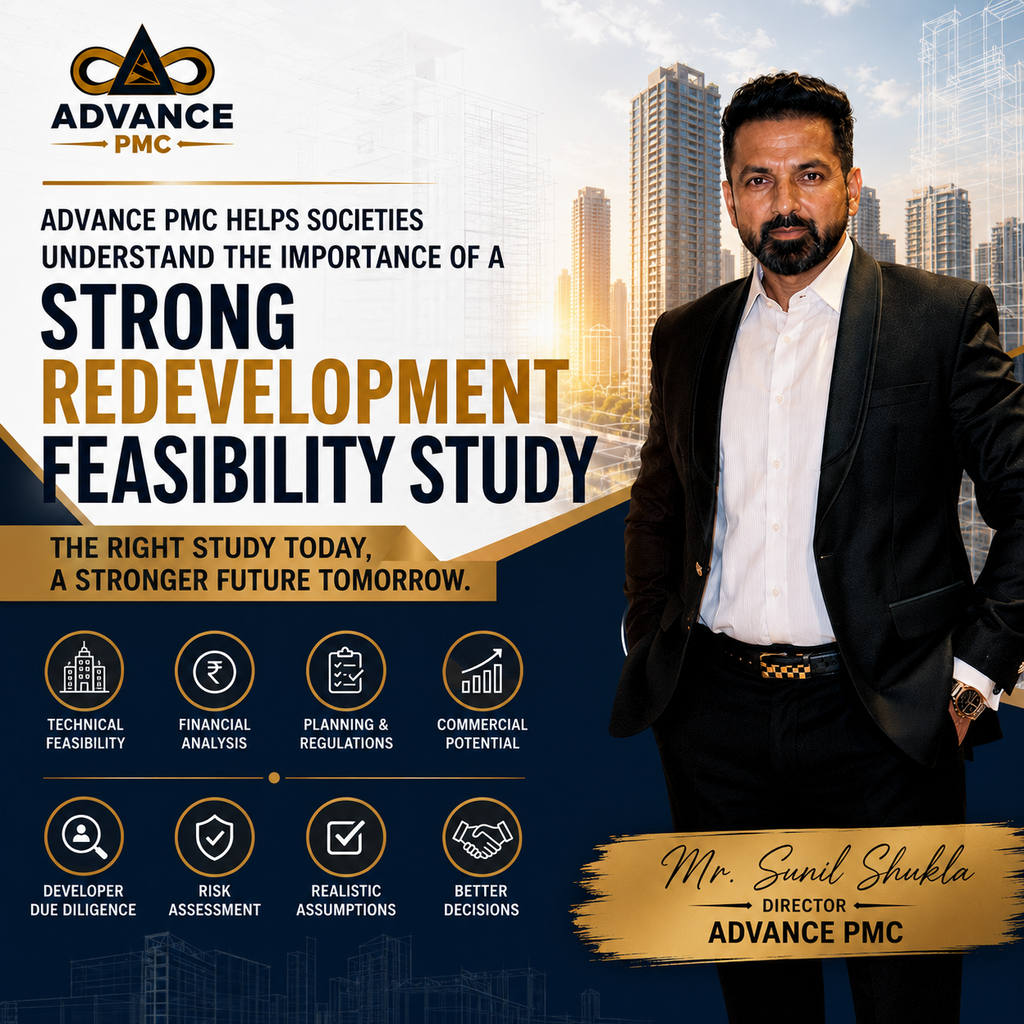
  • Advance PMC Helps Societies Understand the Importance of a Strong Redevelopment Feasibility Study

    Redevelopment begins with an important question: What is actually possible on the society’s property?

    Before discussions move toward developer selection, commercial negotiations, or major commitments, societies need a realistic understanding of their property’s redevelopment potential.

    A feasibility study can provide this foundation.

    Advance PMC helps housing societies examine redevelopment feasibility through a structured assessment of technical, financial, planning, commercial, and project-related factors.

    A property may appear suitable for redevelopment, but the actual possibilities can depend on several conditions.

    Site characteristics, plot dimensions, existing structures, development regulations, permissible development potential, access, planning considerations, construction requirements, and other technical factors can influence the project’s possibilities.

    Financial feasibility is equally important.

    A redevelopment concept needs to be evaluated against construction costs, project expenses, funding requirements, market conditions, expected revenues, and proposed benefits to determine whether the overall project structure is practical.

    This is where assumptions can become important.

    A proposal may include attractive benefits, but those benefits should be examined in relation to the complete project economics.

    Developer capability also forms an important part of feasibility.

    Even when a project appears financially attractive, the developer must have the financial strength, experience, technical resources, and execution capability required to deliver the proposed outcome.

    Advance PMC, under the leadership of Mr. Sunil Shukla, follows a society-first philosophy that encourages committees to understand these factors before making important decisions.

    A feasibility study should not simply answer whether redevelopment is possible.

    It should help societies understand how it may be possible, what conditions could affect it, what risks may exist, and which assumptions require further verification.

    This information can also strengthen future discussions with developers.

    Instead of entering meetings with only expectations, society representatives can approach discussions with a clearer understanding of their property’s potential and project requirements.

    Feasibility assessment can therefore become the foundation for better developer evaluation, negotiation, planning, and decision-making.

    Redevelopment involves long-term consequences. Decisions made without understanding feasibility can create unrealistic expectations later.

    Advance PMC believes societies should understand their property’s potential before evaluating what others promise to deliver.

    Advance PMC – Understand the Potential. Test the Feasibility. Plan with Confidence.

  • Advance PMC Helps Societies Turn Redevelopment into a Better Future

    For a housing society, redevelopment is ultimately about the future.

    The objective is not simply to replace an existing structure. It is to create a better living environment, improve property potential, enhance infrastructure, and create sustainable long-term value for residents.

    Advance PMC helps societies approach this future with professional planning and independent redevelopment consultancy.

    A successful redevelopment journey can begin with understanding the property’s potential.

    It can continue through feasibility assessment, technical evaluation, financial planning, developer due diligence, legal coordination, negotiation support, project management, monitoring, and final handover.

    Each stage contributes to the eventual outcome.

    A weak decision at the beginning can create challenges later. An inadequately evaluated developer can affect execution. Unrealistic financial assumptions can create complications. Poor monitoring can allow quality or progress concerns to remain unnoticed.

    Professional involvement can help societies address these areas more systematically.

    Under the leadership of Mr. Sunil Shukla, Advance PMC follows a society-first philosophy centered on transparency, accountability, independent guidance, and long-term value.

    The future created through redevelopment should be evaluated beyond immediate benefits.

    Will the project provide sustainable value?
    Will the construction meet appropriate expectations?
    Will the developer be capable of delivering the commitments?
    Will the society have adequate visibility during execution?
    Will residents feel confident about the outcome?

    These questions encourage a broader understanding of redevelopment success.

    Every society has its own requirements, priorities, property characteristics, and expectations. Therefore, redevelopment should not be approached as a one-size-fits-all process.

    With the right information, professional guidance, structured planning, and continuous oversight, societies can transform redevelopment from a complicated challenge into an opportunity for long-term improvement.

    Advance PMC believes the best redevelopment outcome is one that serves today’s residents while creating value for tomorrow’s generations.

    Advance PMC – Plan the Future. Protect the Present. Build Lasting Value.

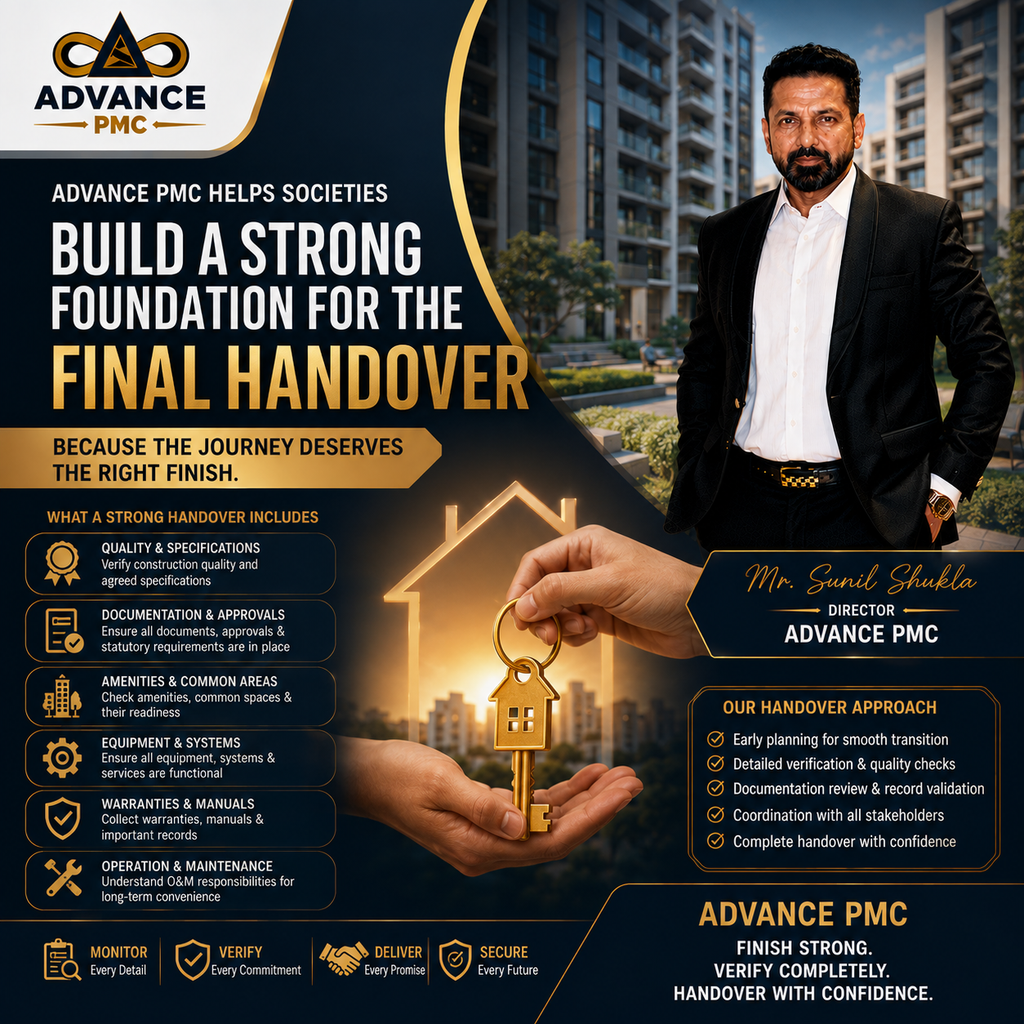
  • Advance PMC Helps Societies Build a Strong Foundation for the Final Handover

    The completion of construction is an important stage of redevelopment, but it should not automatically be treated as the end of the project.

    The final handover represents the transition from construction and project execution toward the society’s new long-term living environment.

    Advance PMC helps societies approach this stage with structured preparation and professional oversight.

    Handover can involve more than receiving possession of a completed building.

    Societies may need to consider quality, agreed specifications, amenities, documentation, approvals, statutory requirements, services, common areas, equipment, warranties, and other project deliverables.

    This is why handover planning should ideally begin well before the final stage.

    During execution, society representatives can maintain records of agreed requirements, project changes, technical observations, and important documentation.

    This creates a useful reference when evaluating the final outcome.

    Advance PMC supports societies through project monitoring, technical assessment, quality reviews, documentation review, coordination, and handover-related verification.

    Under the guidance of Mr. Sunil Shukla, the company follows a society-first philosophy focused on accountability, transparency, and long-term value.

    A structured handover process can help societies identify whether the completed project aligns with the agreed objectives.

    Technical professionals can evaluate relevant construction and quality aspects.

    Legal professionals can assist with appropriate documentation and contractual matters.

    Other specialists may be required depending on the project’s specific requirements.

    The society should also understand the operation and maintenance aspects of the completed development.

    Equipment, systems, common facilities, warranties, manuals, records, and responsibilities may all become important after residents return.

    Handover therefore represents more than a final meeting or possession event.

    It is the point where the society takes responsibility for a newly developed asset that may serve residents for decades.

    A carefully managed handover can help ensure that important matters are not overlooked simply because construction has reached its final stage.

    Advance PMC believes redevelopment success should be measured from beginning to end—including the quality and completeness of the final transition.

    Advance PMC – Finish Strong. Verify Completely. Handover with Confidence.