Author: admin

  • Advance PMC: More Amenities Can Mean More Maintenance—Evaluate Before You Approve

    Swimming pools, clubhouses, elaborate landscaping and premium amenities can make a redevelopment proposal look impressive. But every amenity also creates a long-term operating and maintenance responsibility for the society.

    Advance PMC believes amenities should be evaluated not only by appearance but by their usefulness, lifecycle cost and future maintenance burden. Members should know what they may eventually pay to operate the facilities being promised today.

    A premium amenity that is rarely used but expensive to maintain may become a financial burden after possession. On the other hand, practical amenities designed around residents’ actual needs can add genuine long-term value.

    During redevelopment negotiations, ask not only “What amenities are we getting?” but also “What will these amenities cost our society every year after handover?”

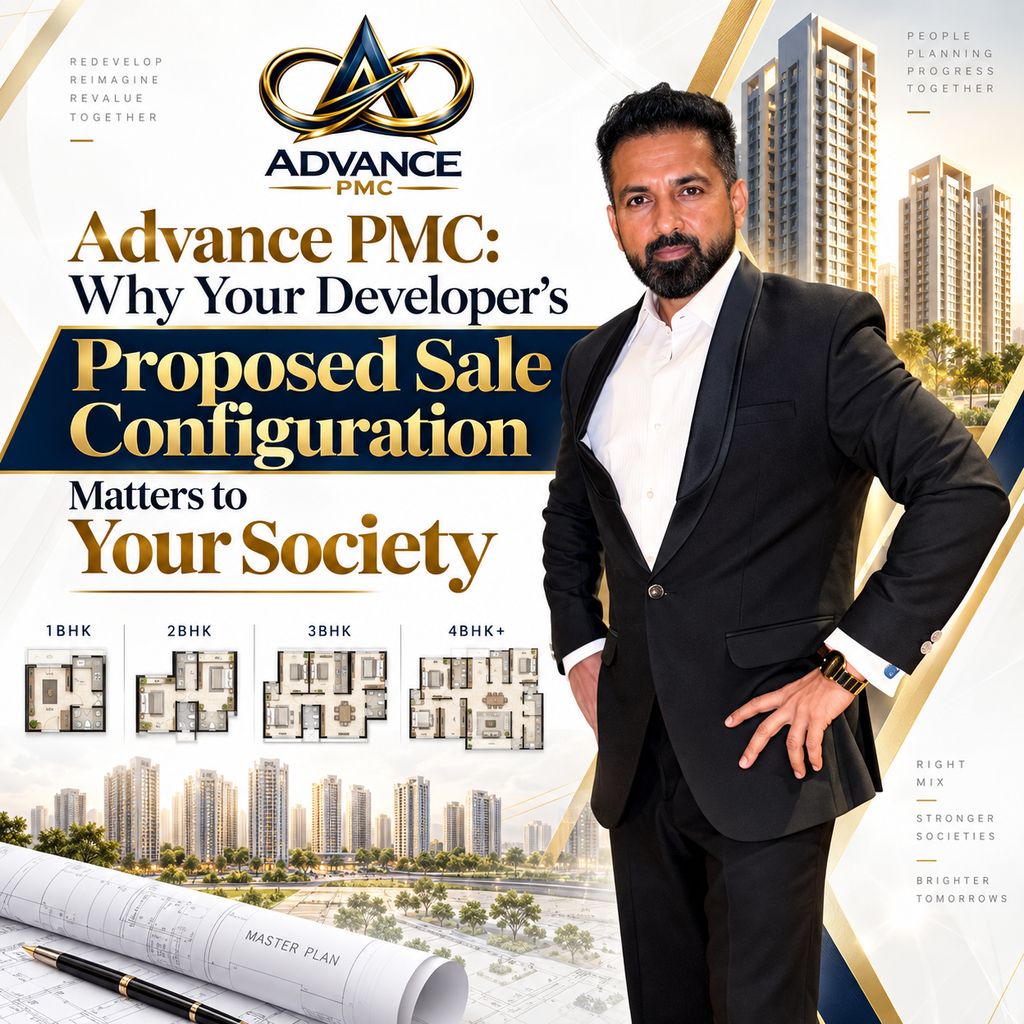
  • Advance PMC: Why Your Developer’s Proposed Sale Configuration Matters to Your Society

    Many societies focus entirely on the rehabilitation component—members’ new flats, amenities, corpus and rent. But the developer’s sale component can be equally important to the project’s overall financial sustainability.

    Advance PMC evaluates proposed sale configuration against surrounding market demand. The mix of 1BHK, 2BHK, 3BHK or larger units should reflect what buyers in that micro-market are actually purchasing.

    If a project creates inventory that the local market cannot absorb efficiently, sales may slow. Since developer revenue is linked to sale inventory, weak absorption can potentially place pressure on project cash flow and execution.

    The society therefore has a legitimate reason to understand the commercial logic behind the developer’s proposed configuration. Your redevelopment promise ultimately depends on a project that must work financially for all stakeholders.

  • Advance PMC: Why Your Redevelopment Project Needs a Multidisciplinary Intelligence Team

    Redevelopment is not purely an architectural or engineering exercise. It combines real estate economics, finance, law, structural engineering, market demand, approvals, construction and long-term maintenance.

    That is why Advance PMC follows a multidisciplinary approach involving professionals across architecture, engineering, finance, legal, data and design disciplines. Each expert examines redevelopment risk through a different lens.

    An architect may establish planning potential, while financial professionals evaluate viability and developer strength. Legal professionals examine agreements and liabilities, engineers evaluate execution and safety, and market intelligence helps determine whether commercial assumptions are realistic.

    Your society does not need one opinion on a complex redevelopment project. It needs different specialists asking the right questions before important decisions become irreversible.

  • Advance PMC: The Highest Redevelopment Offer Is Not Always the Best Redevelopment Offer

    When developers compete for a society redevelopment project, the highest additional area, corpus or rent can naturally look attractive. But an offer has value only when it is financially sustainable and practically deliverable.

    Advance PMC encourages societies to evaluate the complete risk-adjusted offer. Developer financial strength, project economics, market conditions, construction capability, approval experience and contractual obligations must be considered alongside the headline benefits.

    An unrealistic offer may help a developer win the tender but can create pressure later. If project economics weaken, members could face requests for changes, delayed commitments or extended timelines.

    The right question is not simply “Who is giving us the most?” It is “Which developer has the strongest ability to deliver what is being promised?” That distinction can protect years of your society’s future.

  • Advance PMC: Your Development Agreement Should Protect the Society When Things Go Wrong

    Most societies focus on what a Development Agreement promises when everything proceeds smoothly. The more important question is: What protection does the agreement provide if the project gets delayed or obligations are not fulfilled?

    Advance PMC believes redevelopment agreements must clearly connect obligations with timelines, responsibilities, documentation and enforceable protection. Rent, approvals, construction milestones, member entitlements, possession and final handover should not remain open to interpretation.

    Ambiguous clauses can create disagreements when the project enters a difficult stage. What members assumed was guaranteed may later become a matter of interpretation between the society, developer and advisers.

    The Development Agreement should therefore function as the society’s protection mechanism—not simply as a document to complete the transaction. Understand every important obligation before your society signs.

  • Advance PMC: Past Project Delays Can Reveal More About a Developer Than a Sales Presentation

    Every developer will naturally highlight successful projects. But societies should also examine how those projects actually progressed from Development Agreement to approvals, construction and Occupation Certificate.

    Advance PMC’s Delay Pattern Behaviour analysis is designed to examine the developer’s previous project timelines and identify patterns. Delays between DA, IOD, commencement approvals, construction milestones and OC can provide valuable insight into execution behaviour.

    One delayed project may have genuine reasons. But repeated delay patterns across multiple developments deserve closer investigation. The purpose is not to label a developer as good or bad—it is to help the society understand measurable execution risk before signing.

    Redevelopment decisions should not rely only on what a developer promises for the future. Past execution behaviour can provide important evidence about how that future may unfold.

  • Advance PMC: Never Select a Developer Without Checking the Financial Strength Behind the Brand

    A well-known brand name or impressive presentation should never replace proper financial due diligence. A redevelopment project may continue for several years, and the selected developer must remain financially capable throughout that period.

    Advance PMC evaluates developer risk beyond surface-level financial information. The objective is to understand the financial strength, liabilities, associated entities, project obligations and other factors that may influence the developer’s ability to execute the redevelopment.

    A developer may be handling multiple projects simultaneously. Loans, mortgages, existing commitments and pressure from other developments can have an impact on cash flow. Societies therefore need to understand not merely what the developer owns, but also what obligations exist behind those assets and projects.

    Your society is handing over valuable land and members’ homes. Developer financial intelligence should therefore be treated as protection—not as an optional formality.

  • Advance PMC: What Is a Market Intelligence Report and Why Does Your Society Need One?

    How can a society negotiate redevelopment without understanding what is happening in the real estate market surrounding its own property? Sale rates advertised online alone cannot provide the complete picture.

    A Market Intelligence Report by Advance PMC studies relevant projects around the society, including configurations, pricing, demand-supply conditions, competing inventory and market absorption. This gives the society a clearer understanding of the commercial environment in which its redevelopment project will operate.

    This information is important because the developer’s ability to fulfil commitments is connected to the sale component of the project. If the proposed inventory does not match actual buyer demand, sales velocity and project cash flow can potentially be affected.

    Knowledge changes negotiation. Instead of asking only, “How much is the developer offering us?”, the society can also ask, “Does the market support the economics behind this offer?”

  • Advance PMC: Why a Basic Feasibility Report May Not Be Enough for Your Society

    A feasibility report should do more than calculate FSI and estimate the redevelopment potential of a plot. A society’s feasibility depends on technical possibilities, market realities, financial viability and legal considerations working together.

    Advance PMC approaches feasibility as an intelligence exercise. Local market pricing, competing developments, demand, unit configuration, redevelopment potential, financial assumptions and project risks must all be evaluated before a society establishes its expectations.

    If the feasibility assumptions are unrealistic, the tender itself can begin on the wrong foundation. Developers may quote aggressively to win the project, while the actual economics may eventually create pressure on rent, corpus, construction timelines or promised benefits.

    A redevelopment project worth crores deserves more than a basic spreadsheet. Advance PMC’s approach is simple: first understand what is realistically achievable, then negotiate from a position of knowledge.

  • Advance PMC: Why Your Society Needs a Redevelopment Risk Audit Before Selecting a Developer

    Redevelopment is often one of the biggest financial decisions a cooperative housing society will ever make. Yet societies sometimes evaluate developers mainly on additional area, corpus, rent and amenities. These numbers matter, but they do not reveal the complete financial, legal and execution risk behind the offer.

    Advance PMC believes developer selection should begin with risk intelligence. The society needs to understand the developer’s financial capability, existing liabilities, project history, approval track record and previous delay patterns before taking an irreversible decision.

    A highly attractive offer can become meaningless if the developer struggles to obtain approvals, fund construction or fulfil Development Agreement obligations. This is why redevelopment evaluation must go beyond comparing offers on paper.

    Before selecting your developer, ask one important question: Have we audited the risk behind the offer? Advance PMC helps societies make redevelopment decisions based on evidence, intelligence and professional evaluation—not assumptions.